
Blog
What Is the Difference Between Orange Sponge and Blue Sponge?

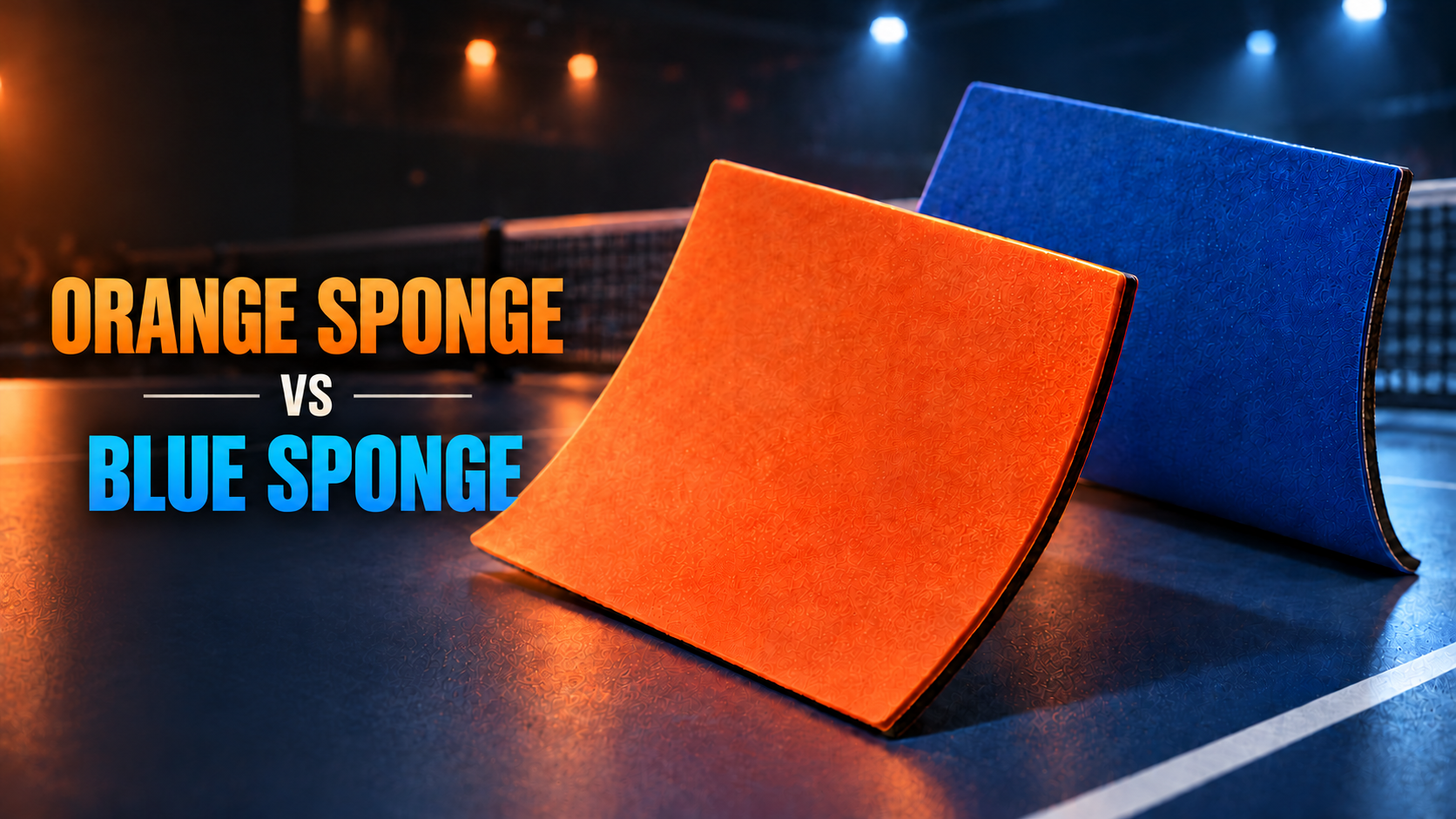
When I was a kid, I thought all table tennis sponges were orange. I had hardly seen any other color. Then one day, a friend told me he had bought a blue-sponge Hurricane 3. I had no idea that version even existed, so I immediately asked him what was different about it.
“Professional players use blue sponge,” he told me. “It costs more, and it’s better.” At the time, I did not know enough to question that answer.
Over the years, more and more customers and fellow players have asked me the same question: what is the difference between orange sponge and blue sponge? I felt it was worth writing a proper explanation, because “more expensive means better” does not tell you which one will actually suit your game.
Hurricane is not the only Chinese rubber family available with different sponge options. You will also come across orange- and blue-sponge versions in ranges such as 729 Battle, Palio CJ8000, and Sanwei National. To keep this comparison clear, I will focus on the Hurricane series throughout this article. The same questions about feel, ease of engagement, and power requirements can help you compare other rubbers, but sponge color alone does not guarantee the same characteristics across different brands.
What Makes the Two Sponges Different?
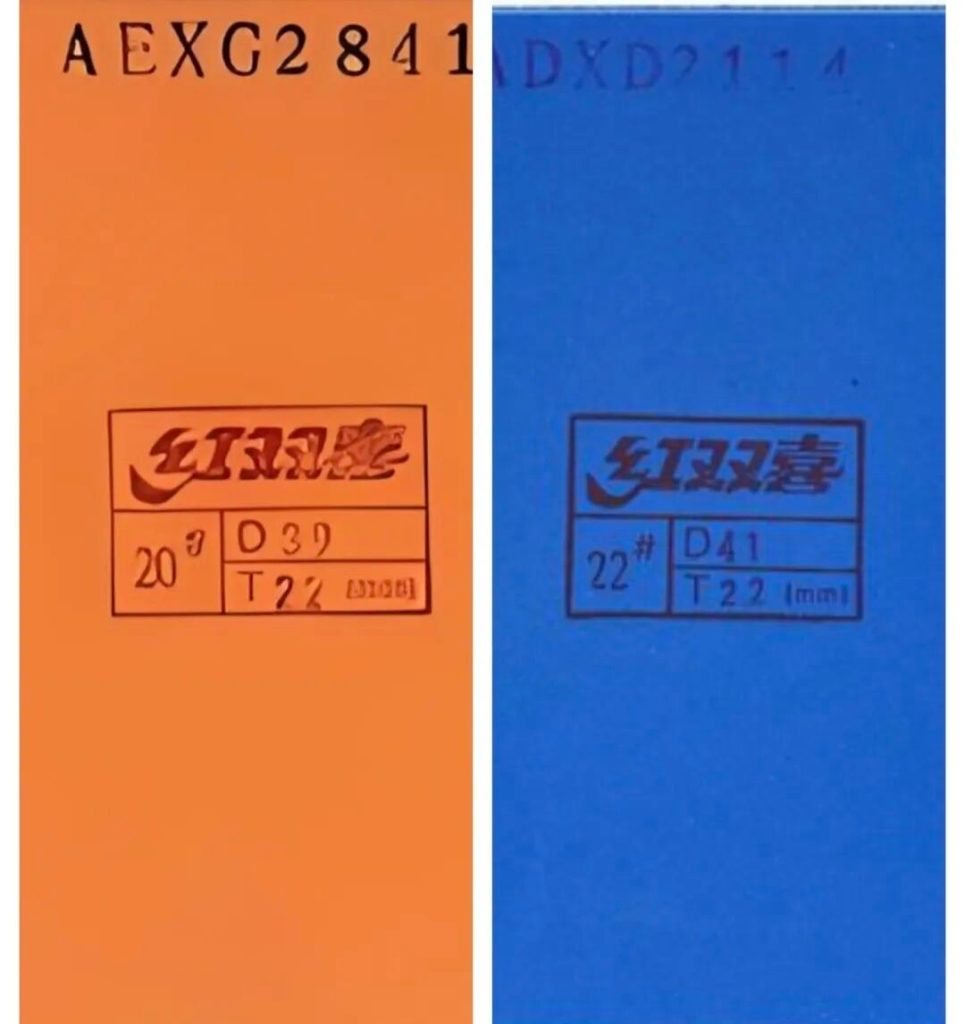
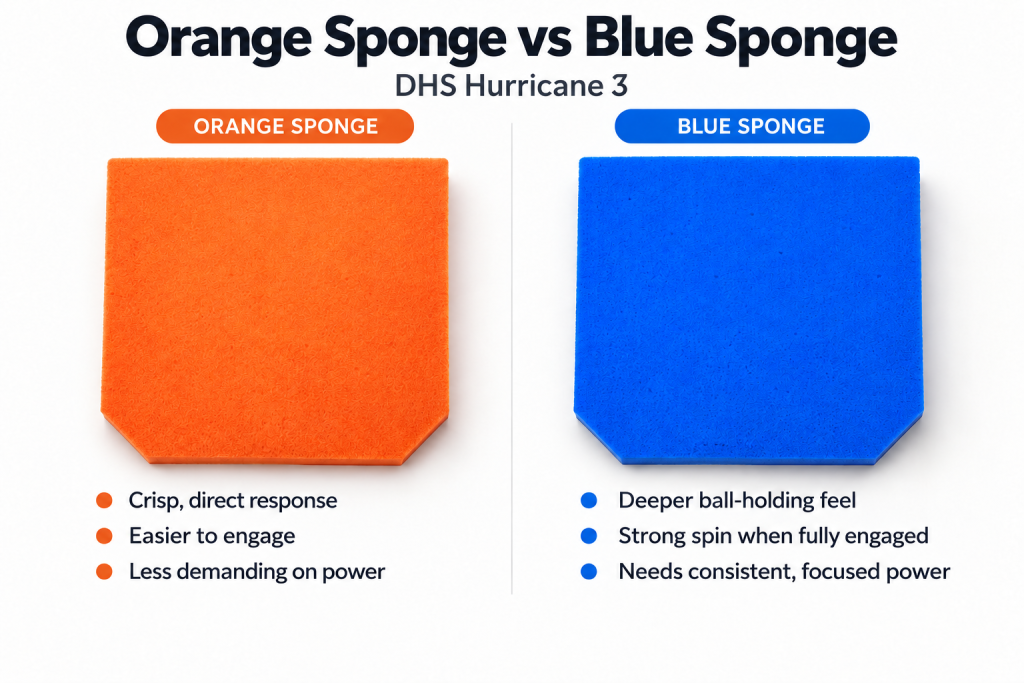
In the Hurricane 3 comparison discussed here, orange sponge is identified as No. 20 sponge, while blue sponge is identified as No. 22. The difference is not simply the color. These sponges have different playing characteristics. This does not mean that the same comparison applies to orange and blue sponges from every other brand.
Orange sponge gives a crisp, direct response and is easier to engage with moderate effort. Blue sponge has a more resilient feel, with a deeper holding sensation, but requires more concentrated power to bring out its strengths. Hardness, thickness, blade choice, and treatment also affect the result, so color should not be considered on its own.
| Characteristic | Orange Sponge | Blue Sponge |
|---|---|---|
| Main playing feel | Crisp and direct | Resilient, with a deeper holding sensation |
| Effort required | Easier to engage with moderate power | Requires more concentrated power |
| Main strength | Accessible response and a natural arc | Strong spin and support when fully engaged |
| Best-suited style | Close-to-table and mid-distance loop-drive play | Active looping and sustained mid-distance attacks |
| Dependence on treatment | Less dependent on additional treatment | More dependent on treatment to release its potential |
The Rubber Band Analogy
To make the difference clearer, especially for players who are new to table tennis, I’ll use a simple rubber band analogy.
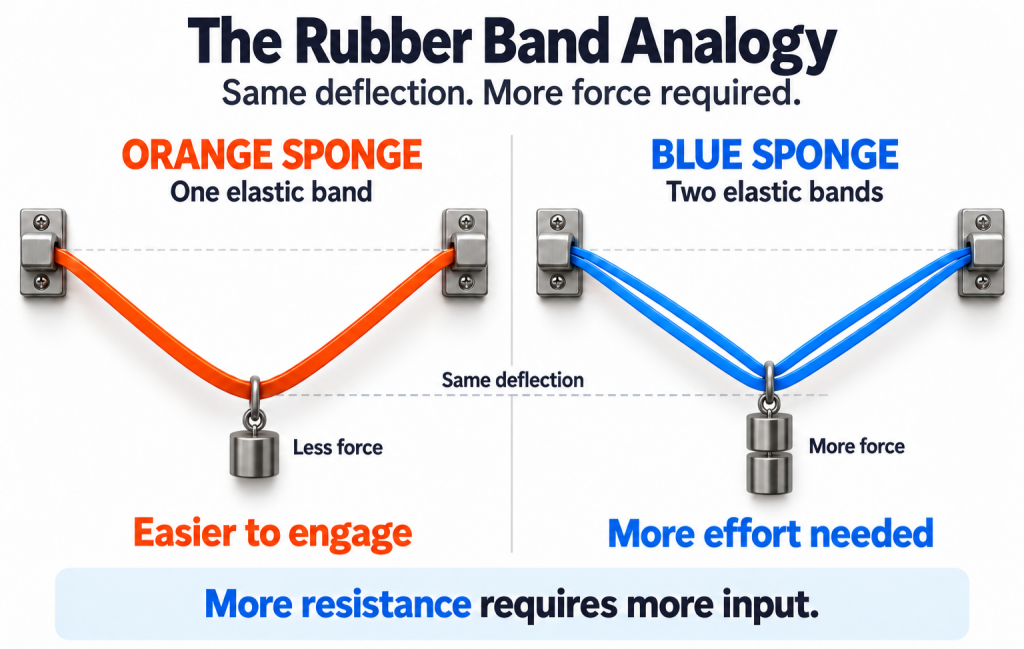
Imagine stretching one rubber band between two fixed points and pressing down on its center. It gives way relatively easily. This represents orange sponge. Now place a second identical rubber band alongside the first and press them together. You need more force to push them down by the same amount. This represents blue sponge.
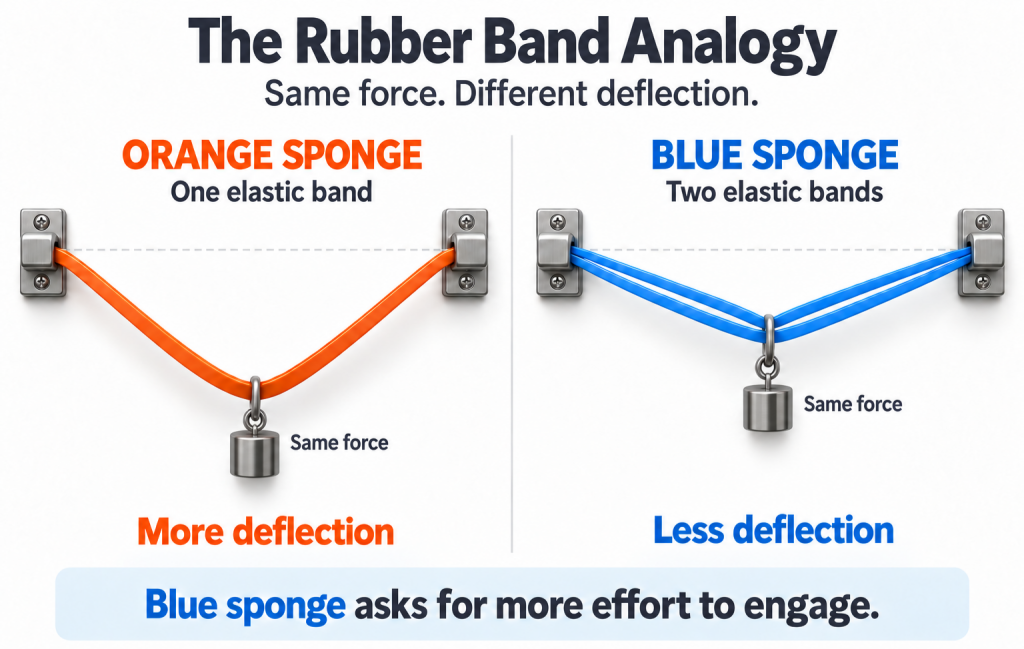
The illustration explains the difference in effort, not the actual structure of the sponges or a measured force ratio. With orange sponge, moderate input can more readily produce useful compression and rebound. Blue sponge asks for more input before you access its deeper response.
Players sometimes describe this as “hitting through” the rubber. I use that expression to mean engaging the sponge properly, rather than making only a light contact with the topsheet. It does not mean the ball physically reaches the blade. The important point is that greater resistance is only useful when your stroke can work with it.
Orange Sponge: A Crisp Response with Less Effort
Orange sponge is often described as firm, crisp, and springy. It responds directly, making it easier to get the ball moving without a large or especially forceful stroke. At moderate effort, it is more readily engaged than blue sponge.
That explains its quick initial release: the ball comes away readily at everyday playing effort. This is not the same as saying orange sponge always produces a higher maximum ball speed. Its advantage is that you can access a useful response without putting everything into the shot.
Orange sponge also offers a relatively natural arc. When opening against backspin, it is easier to obtain a trajectory that clears the net without requiring such concentrated input. That accessibility matters when you are slightly late, out of position, or unable to prepare a full stroke.
I would not describe these qualities as useful only for beginners. An experienced player can deliberately choose orange sponge for its direct response and easier attacking rhythm. A rubber that helps you repeat a good shot can be more valuable than one that produces a stronger ball only under ideal conditions.
Blue Sponge: More Hold, Spin, and Support
Blue sponge has a more resilient feel, with a deeper sense of holding the ball. When properly engaged, it offers strong spin and solid support under a committed stroke. Its appeal is especially clear for players who actively accelerate through the ball.
The longer holding sensation also places greater demands on the stroke. You need to keep the movement positive through contact, rather than producing a brief burst of effort and expecting the rubber to do the rest. Concentrated, coordinated power matters more than simply swinging harder.
A cushioned contact should not be confused with an easy attacking response. Blue sponge can feel relatively soft or controlled at first touch while still demanding considerable effort to produce a powerful loop. These are different aspects of its behavior.
Most importantly, being able to hit one strong shot is not enough. You need to produce that quality again on the next ball. If your first attack leaves you off balance or late for the follow-up, blue sponge becomes much harder to use effectively.
How Do They Compare in Actual Play?
When opening against backspin, orange sponge makes it easier to create a reliable arc without putting too much effort into the stroke. Blue sponge can produce stronger spin with a committed opening, but it asks more of your timing and acceleration. The advantage only matters if you can produce that quality consistently.
Closer to the table, there is often little time to prepare a full stroke. Orange sponge’s crisp, direct response works well in these situations, helping you play quick loops and drives while using the opponent’s pace. Blue sponge can also perform well here, but even a short stroke needs concentrated power to engage it properly.
As you move away from the table, blue sponge becomes more appealing. With more room to complete your stroke, you have a better opportunity to use its deeper holding sensation and strong support. Players who can repeatedly generate their own power are more likely to benefit from it in sustained topspin rallies. The challenge is maintaining that quality as the rally continues, rather than producing just one powerful ball.
I would not treat these differences as strict rules about where either sponge belongs. I would judge the choice by your normal rally quality, not your best single loop. Your second and third attacks, especially when the opponent puts you under pressure, tell you more about whether a rubber suits your game than one perfectly prepared opening shot.
Do You Need to Boost Blue and Orange Sponge?
If you do not intend to boost your Hurricane 3, I would favor orange sponge. Its more natural arc and accessible response make it the easier starting point for someone who wants less preparation and maintenance.
Blue sponge is more dependent on treatment to bring out its deeper power. Without additional treatment, it can feel relatively muted or reluctant to release the ball, even when the initial contact feels comfortable. This is why a pleasant holding sensation does not necessarily translate into an easy attacking game.
That does not mean blue sponge is impossible to use without boosting. It means that playing with it and fully benefiting from its strengths are different things. I would include your willingness to prepare and maintain the rubber in the buying decision, alongside your technical ability.
In general, though, blue sponge needs boosting to bring out its best qualities and make the most of its advantages.
Treatment also changes perceived hardness and response. A description of a boosted sheet should therefore not be taken as a direct description of the same rubber straight from its package. This is a discussion of playing characteristics, not a statement that a particular treatment is permitted in competition.
Which Sponge Would I Recommend for Your Game?
I would recommend orange sponge if you want reliable performance without having to force every stroke. It suits close-to-table and mid-distance loop-drive play, quick transitions, and players who value a direct response. It is also the more practical choice if you do not want to spend much time maintaining your rubber.
Orange sponge makes particular sense when you can produce a good opening attack but find it harder to maintain that power over several shots. Choosing it is not settling for an inferior option. You are choosing characteristics that help you play your own game more consistently.
I would recommend blue sponge if you can generate concentrated power repeatedly. That means maintaining your footwork, contact point, and acceleration through successive attacks, rather than merely hitting hard during a comfortable practice drill. Active loopers who enjoy mid-distance exchanges are more likely to benefit from its strengths.
Before paying extra, I would ask: Can you use the extra performance during an ordinary match, including when you are under pressure? If the answer is yes, blue sponge has a clear purpose. If it only feels better on your strongest, best-prepared shots, orange sponge may give you better overall results.
Some Final Thoughts
After looking at all these differences, my main point is simple: more expensive table tennis equipment is not necessarily better for you. The best choice comes from understanding each option and finding what suits your game. Orange sponge offers a more accessible response, while blue sponge demands more from your strokes and preparation.
Orange and blue sponge suit different needs; choosing blue sponge is not automatically an upgrade.
The rubber band analogy helps explain why: greater resistance is only useful if you can consistently provide the effort needed to work with it. Being able to hit one powerful loop with blue sponge does not necessarily make it the better choice. What matters more is how well the sponge supports your game throughout a match, especially when you are rushed or under pressure, rather than how impressive your best single shot can be.
