
Blog
Joola Hugo Calderano ARY-C Review

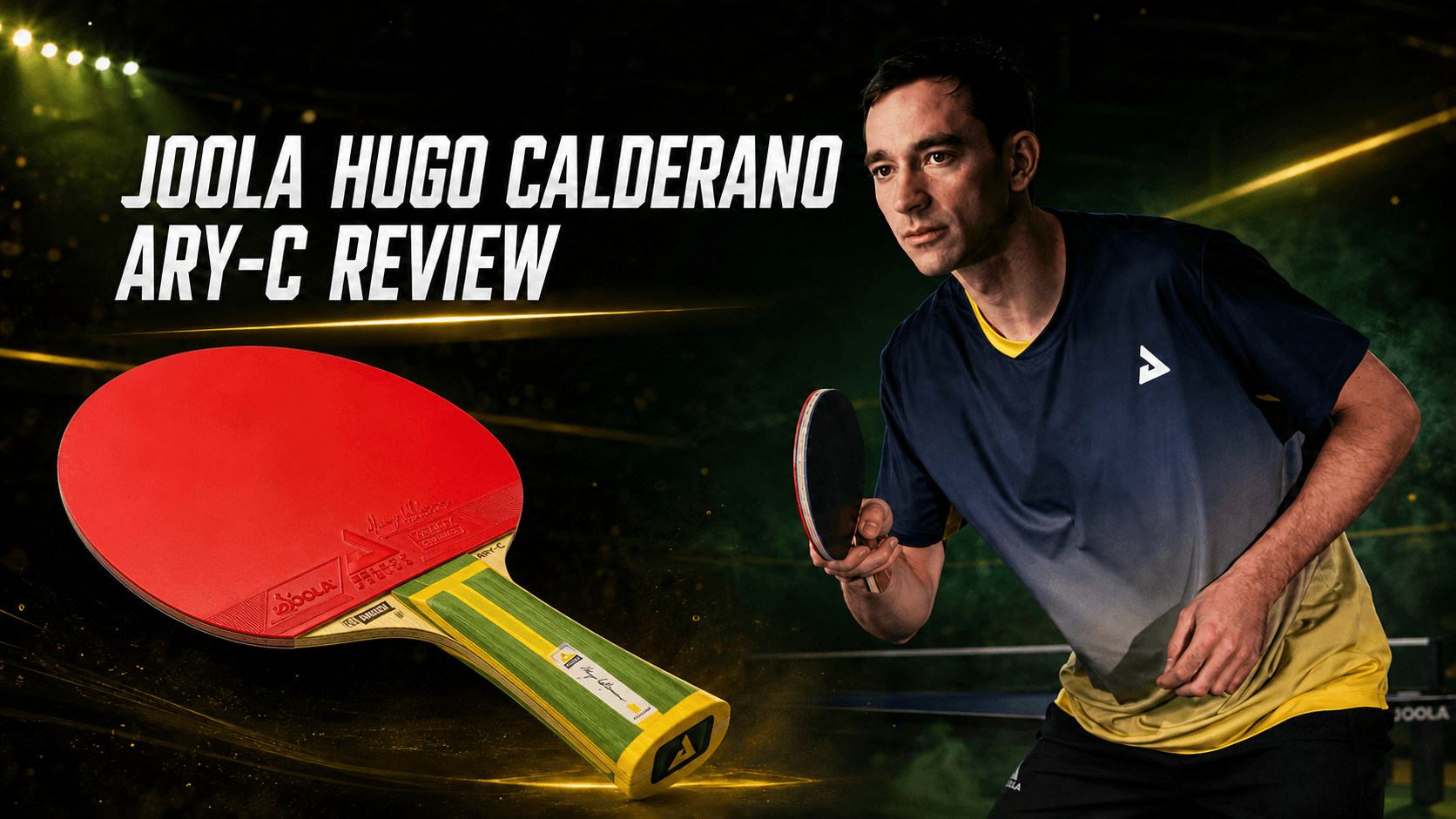
When Hugo Calderano signed with JOOLA in 2026 and moved away from the XIOM blade he had used for years, the decision immediately drew huge attention. JOOLA developed a specially made blade for him, and naturally, many players were curious: would this new setup really match the level of equipment Hugo had relied on for so long?
In fact, when the JOOLA Hugo series was released this year, not everyone was convinced. A lot of that skepticism had to do with Hugo’s own results. In 2025, Hugo Calderano was playing at a truly world-class level. He won the Men’s Singles title at the World Cup, reached the Men’s Singles final at the World Championships, and climbed as high as No. 2 in the world ranking. But in 2026, especially in the first half of the year, his results were not as impressive as many fans had expected. Inevitably, some people began to wonder whether the change of blade had affected his performance.
There was already plenty of guess even before this blade officially came out. After all, the blades supplied to Hugo by JOOLA and XIOM are believed to come from the same Korean manufacturer, so in theory, the performance gap should not be dramatic. With that question in mind, we took a close look at the newly released Joola Hugo Calderano ARY-C to see what this blade is really about.
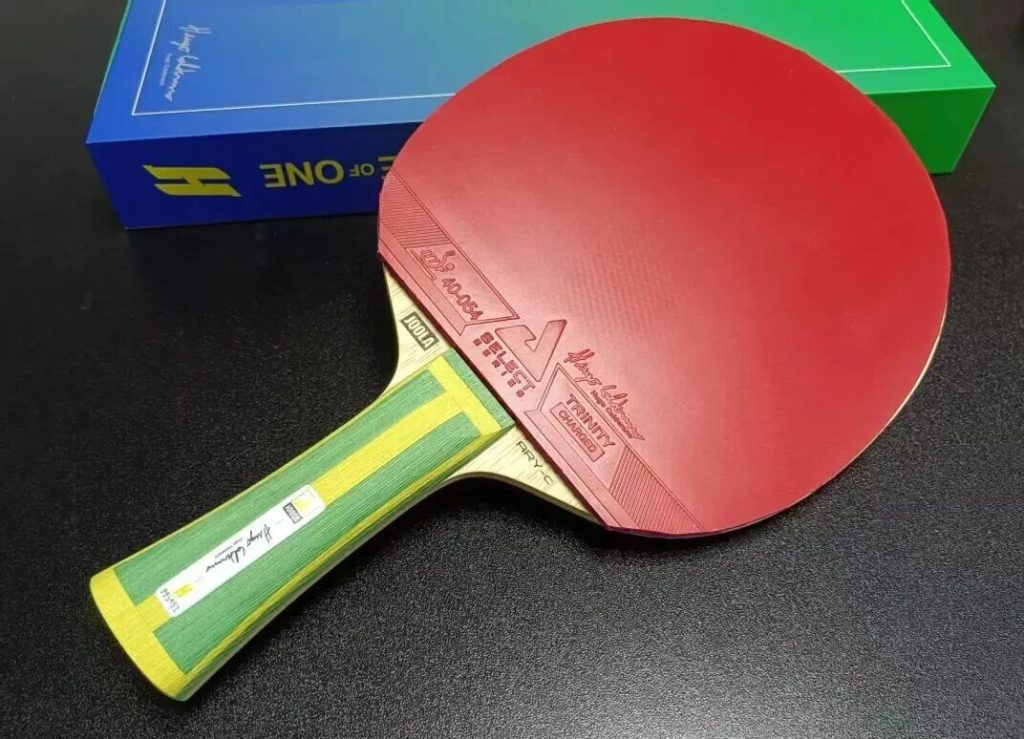
Hugo Calderano’s Current Setup: Blade and Rubbers
Hugo’s current setup also gives us a useful reference point for understanding this blade. According to Joola’s official information, he is using the Joola Hugo Calderano ARY-C blade with Trinity Hugo Calderano Charged on the forehand and Trinity Hugo Calderano Dynamic on the backhand. This is a very logical combination.
The ARY-C blade provides the structure, dwell, and power reserve, while the harder Charged rubber on the forehand helps produce heavy, direct attacks with strong spin and speed. On the backhand, the slightly more versatile Dynamic rubber makes sense for Hugo’s fast exchanges, counters, and quick transitions close to the table. In other words, his setup is not simply built for maximum speed; it is designed to keep the balance between power, stability, spin, and control.
Structure And Feel
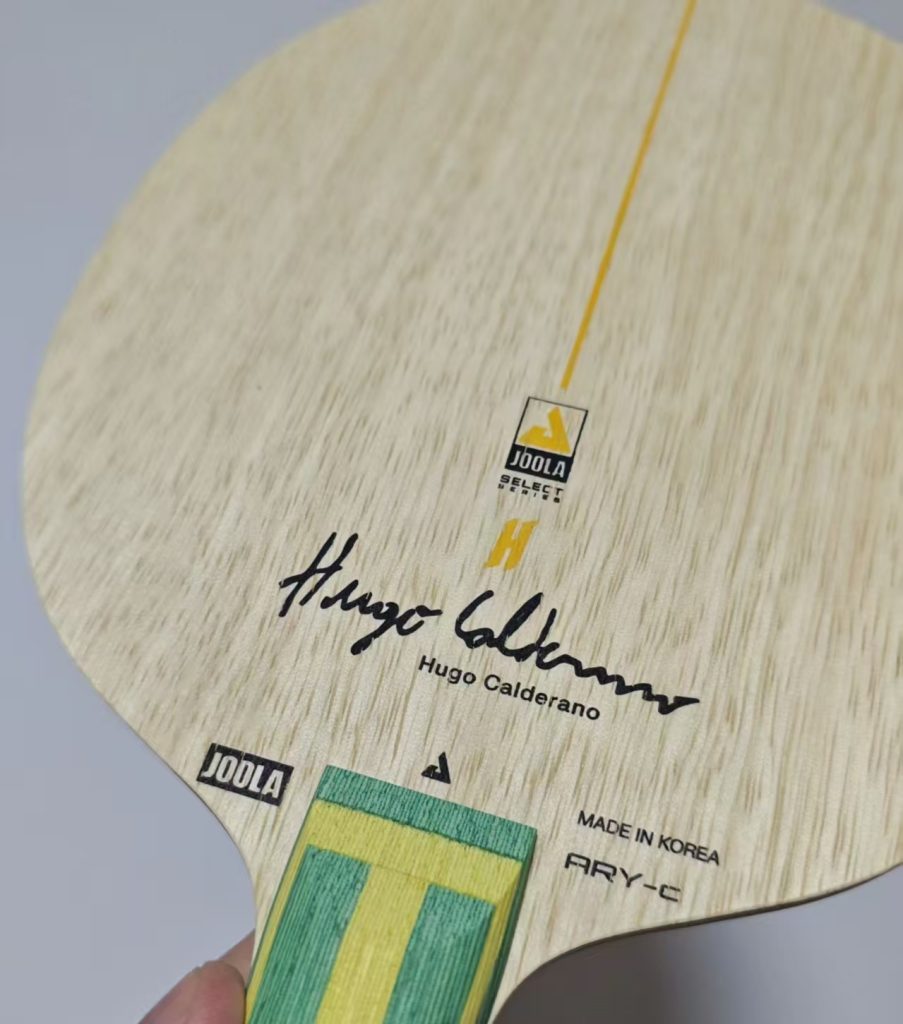
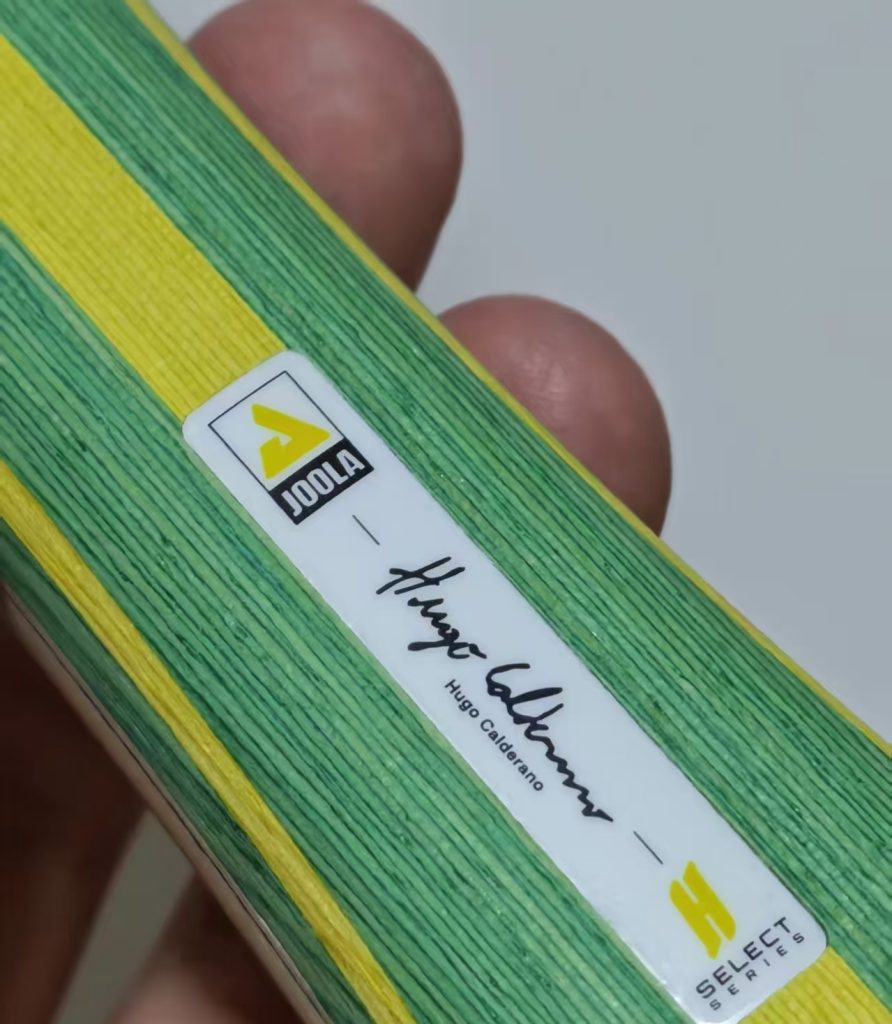
The Hugo ARY-C uses a limba outer ply, ayous medial ply, green arylate-carbon fiber, and an ayous core. In concept, the construction is somewhat similar to the DHS W968, but the use of green arylate-carbon gives it a different response.
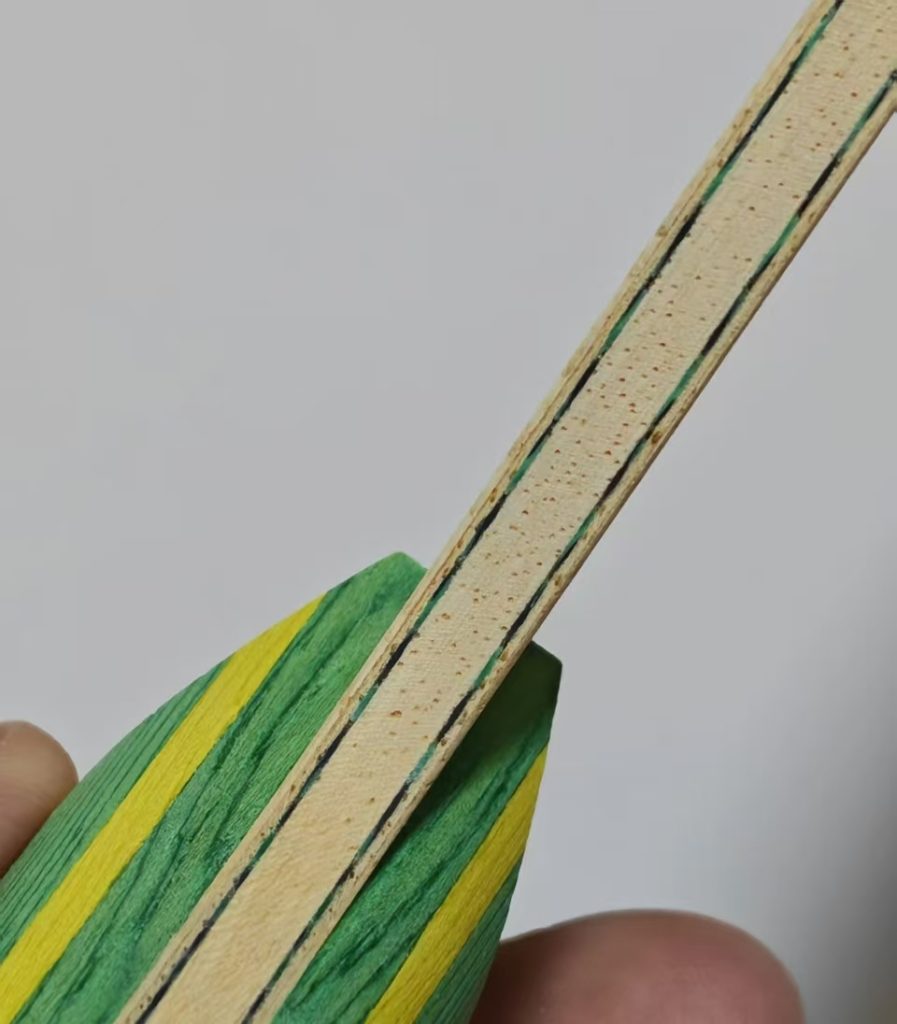
As I mentioned in our previous review of the Stiga Luma Hybrid Carbon, green arylate-carbon is very likely to become one of the important directions in the blade market going forward. This is not just a random guess. In 2026, almost every major brand seems to have introduced some form of green arylate-carbon blade, which says a lot about where the market is moving. That said, judging from the current market response, the Stiga Luma Hybrid Carbon appears to have received slightly more attention and popularity than the Hugo ARY-C so far.
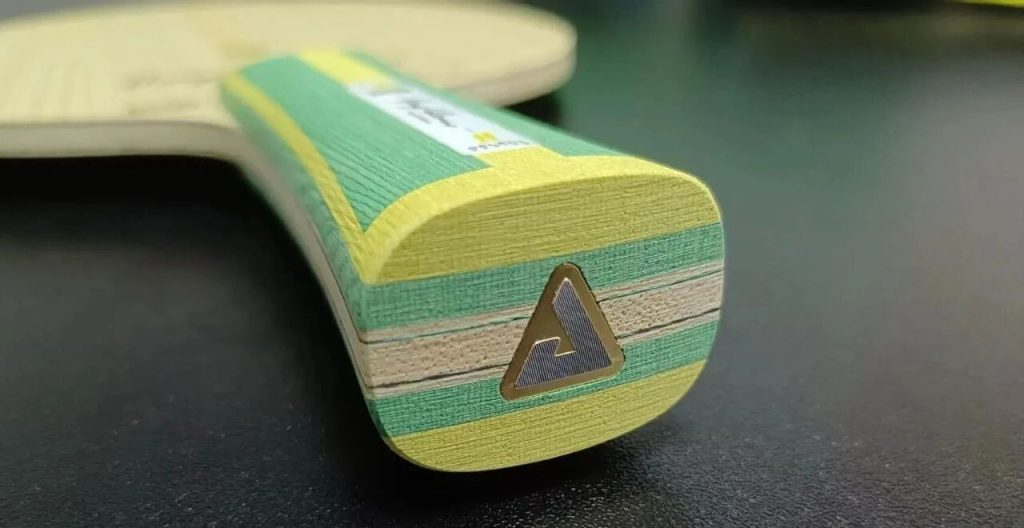
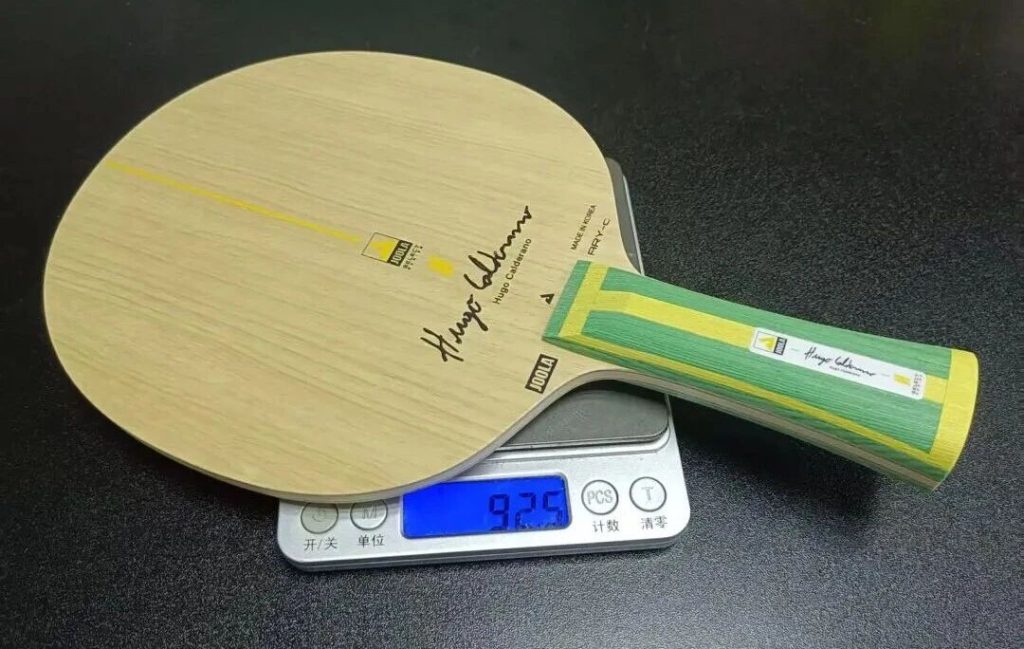
Compared with other inner green arylate-carbon blades, such as the Donic JO Waldner Gold Edition and Stiga Aura Hybrid Carbon, the Hugo ARY-C feels thicker, fuller in the hand, and more rigid. The tested blade measured around 6.05 mm thick and weighed approximately 92.5 g, with a relatively large head size of about 159 x 152 mm.
The first impression is clear: this is not a soft, easy-to-bottom-out blade. It has a firm body, strong support, and a certain power threshold. At the same time, it is not overly demanding. Even at medium impact, it already produces good ball quality, which is one of the reasons the blade feels so complete.
Short Game And Control
For a blade with this level of stiffness and rebound, the short game is surprisingly controlled. It does not feel overly bouncy in passive touch play, which is important for a blade that has such a solid structure and clear power reserve. When paired with a slightly tacky rubber such as JOOLA Hugo Trinity Charged, short pushes and long pushes can be kept low, direct, and stable.
In short touch play, the Hugo ARY-C gives a fairly clean and predictable response. The ball does not jump off the racket too suddenly, so it is possible to keep the first touch tight over the table. On short pushes, the blade offers enough firmness to keep the contact crisp, but it still allows the rubber to grip the ball and control the depth. On long pushes, the trajectory is low and fast, which makes it easier to apply pressure instead of simply returning the ball safely.
On receive, especially with backhand banana flicks, the blade grips the ball well and provides more spin than expected. You can feel the blade supporting the shot at impact, helping create a strong and stable arc without requiring excessive effort. This is where the green arylate-carbon layer shows its value: it gives support without making the blade feel too hollow or too springy in the hand.
This is an important detail. Many powerful blades give you speed and support, but ask you to sacrifice touch. The Hugo ARY-C does a good job of keeping that balance. It has enough firmness to make the ball leave cleanly, but not so much unwanted rebound that the short game becomes difficult to manage. For advanced players who rely on serve receive, placement, and quick opening shots, this balance makes the blade much more usable in real match play.
Forehand And Backhand Performance
On the backhand side, the Hugo ARY-C is particularly convincing. Compact strokes can already produce excellent speed, while the blade’s rigidity gives strong support in blocking, countering, and quick exchanges. This is one of the most impressive parts of the blade. Although it is an inner-fiber construction, the backhand does not feel weak, delayed, or lacking in rebound compared with many outer-carbon blades. It still retains enough dwell and ball-holding sensation to make spin generation reliable, but the response is direct enough for fast modern backhand play.
In backhand rallies, the blade feels very secure. You do not need a large swing to create quality. A short forward movement is enough to borrow the opponent’s power and send the ball back with speed and depth. This makes the Hugo ARY-C very effective in close-to-table exchanges, especially when you are taking the ball early, changing direction, or adding pressure through quick timing. The blade gives a clear sense of support at impact, so it is easy to stay confident even when the rally speed increases.
Blocking and countering on the backhand are also strong. The blade has enough stiffness to resist heavy incoming topspin, but it does not feel completely rigid or dead. There is still a small amount of hold, which helps keep the ball on the racket long enough to adjust the angle and placement. This combination of firmness and control is what makes the backhand side feel so complete. It is fast, stable, and very practical in real match play.
On the forehand side, players with larger strokes may notice that the blade is not extremely easy to fully penetrate. It requires commitment, timing, and a fairly complete forward impact to unlock its full depth. The blade is not the kind that immediately bottoms out with light contact. Instead, it asks the player to engage it properly. For players with strong forehand technique, this can be a benefit, because the blade has a deep power reserve and does not collapse under pressure.
Even so, the Hugo ARY-C is fast for an inner arylate-carbon construction. It performs well in both loop-drive and power-loop situations, offering a strong combination of speed, spin, and stability. In medium-impact forehand loops, the ball already carries good quality. When you accelerate harder, the blade gives a more solid and penetrating response, with enough support to continue attacking through the rally.
The forehand is not the softest or most effortless type, but once you engage the blade properly, the quality is high. The ball carries good weight, the arc is solid, and the blade gives enough support for continuous pressure. It may not be the easiest forehand blade for every amateur player, but for advanced players who can generate their own power, the Hugo ARY-C offers a very strong and reliable attacking feeling.
Mid-Distance And Power
At mid-distance and even farther from the table, the Hugo ARY-C shows one of its biggest strengths: support. The blade does not collapse under heavy impact. Its rigidity and rebound allow the player to continue applying pressure without feeling that the blade is losing stability.
This is where the blade starts to feel especially high-level. When you step back from the table, many inner-fiber blades can begin to feel a little soft or insufficiently direct. The Hugo ARY-C is different. It keeps its structure, gives you enough rebound, and still lets you produce heavy, stable shots from distance.
That makes it especially suitable for modern two-winged attackers who need reliable backhand speed, strong forehand quality, and enough power reserve for rallies away from the table.
Rubber Pairing
The Hugo ARY-C works well with both tensor rubbers and tacky or hybrid rubbers. A setup with Butterfly Tenergy on both sides performs well, offering speed, grip, and a clear feeling on impact. However, the forehand may not be easy to fully activate for every player, especially if the player does not have a strong enough forward impact.
Interestingly, pairing the forehand with Joola Hugo Trinity Charged, despite its higher hardness, creates a very suitable combination. The key is not necessarily to hit through the blade completely every time, but to find a rubber that provides enough clarity, grip, and energy transfer.
For players who like tacky or hybrid rubbers, the blade has enough support to make those setups work well. For players who prefer European or Japanese rubbers, it still offers enough dwell and control to prevent the setup from becoming too direct. The safest direction is to choose rubbers that add grip and arc without making the whole setup too stiff or too heavy.
Some Final Thoughts
The Joola Hugo Calderano ARY-C is an extremely balanced high-performance blade. It reaches a very high level in speed, spin, power, control, and defensive stability, without showing any obvious weakness. Its backhand support is excellent, the short game is more controlled than expected, and its performance from mid-distance is genuinely impressive.
The main limitations are its thickness, rigidity, and slight power threshold. Players used to thinner blades under 5.8 mm may need time to adjust, and those who prefer very soft, easy-flexing blades may find it a little demanding. It is not the kind of blade that feels instantly soft or effortless from the first hit. Instead, it asks for a certain level of impact and timing before its full quality comes out.
That said, this is still a very serious flagship blade. For advanced offensive players who want an inner-fiber blade with strong structure, reliable spin, and enough power reserve for modern two-winged attacking play, the Hugo ARY-C is a genuinely impressive option. It has enough control for technical play, but also enough strength to reflect the aggressive style associated with Hugo Calderano himself.
