
Blog
Stiga Luma Hybrid Carbon Review

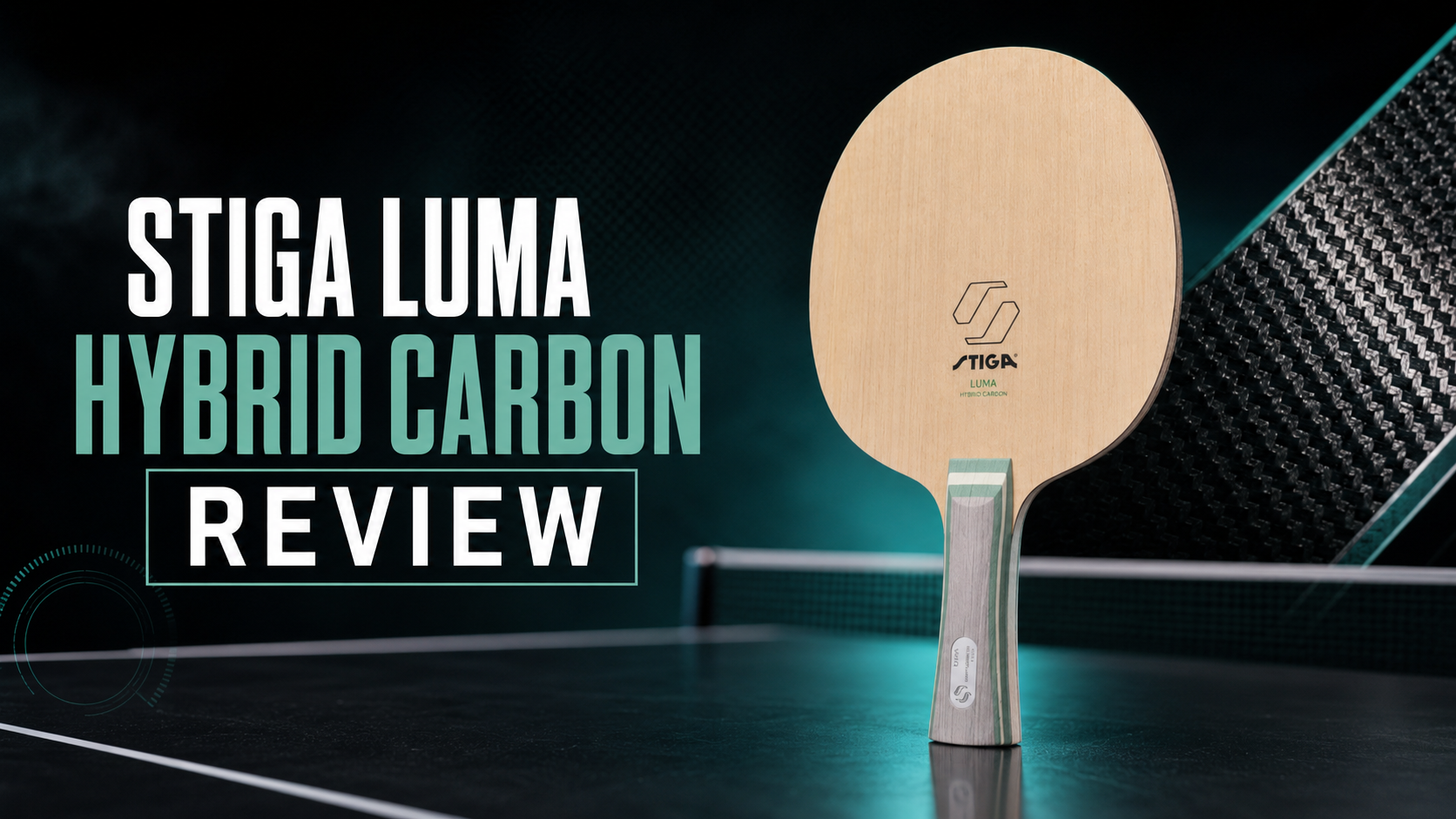
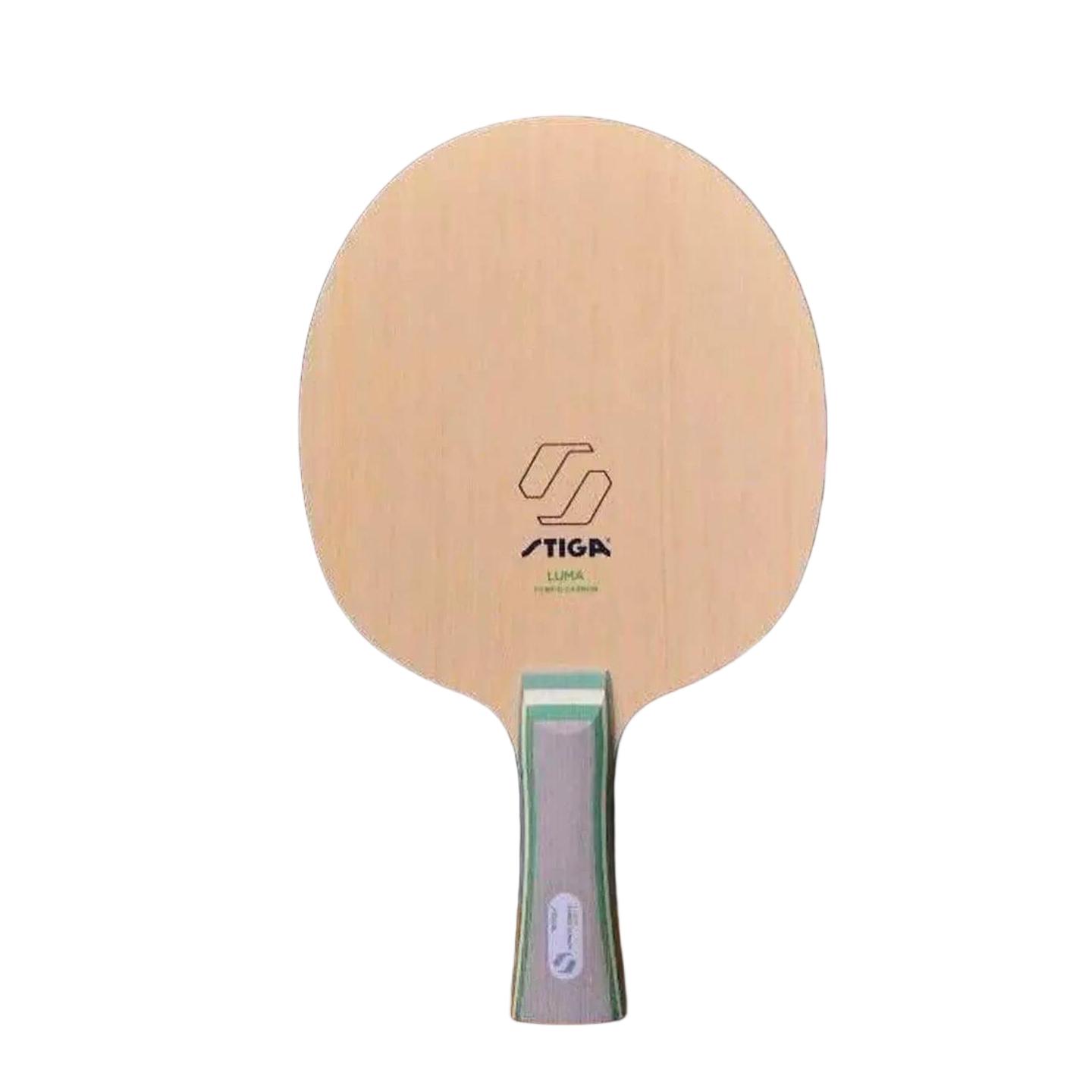
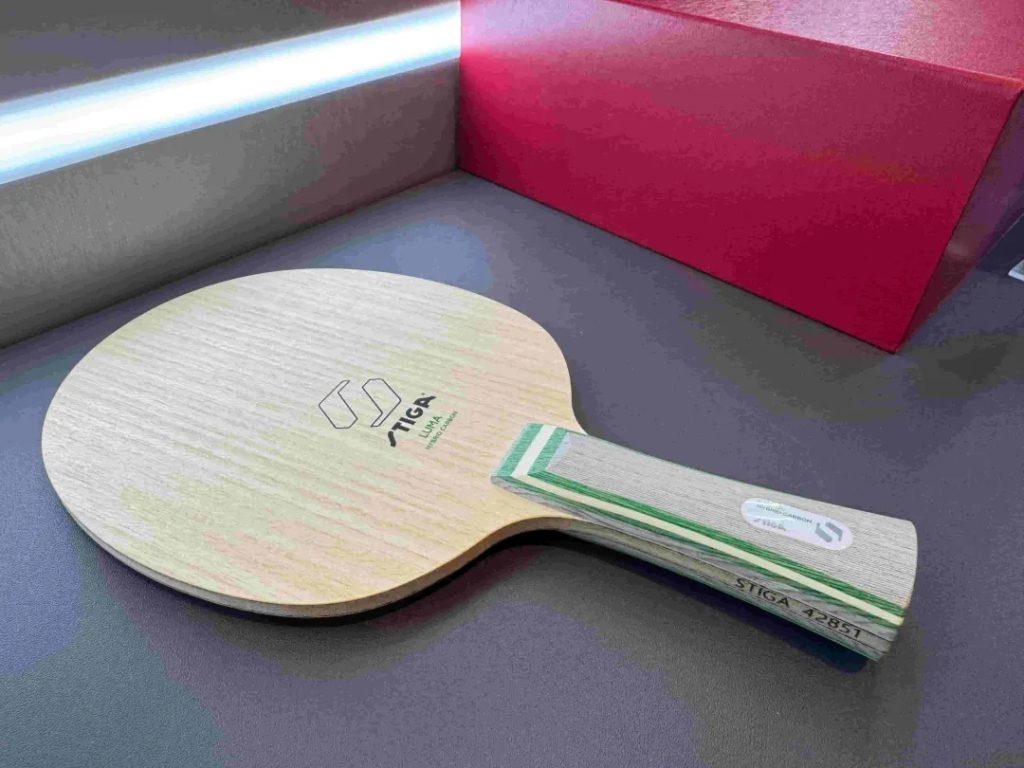
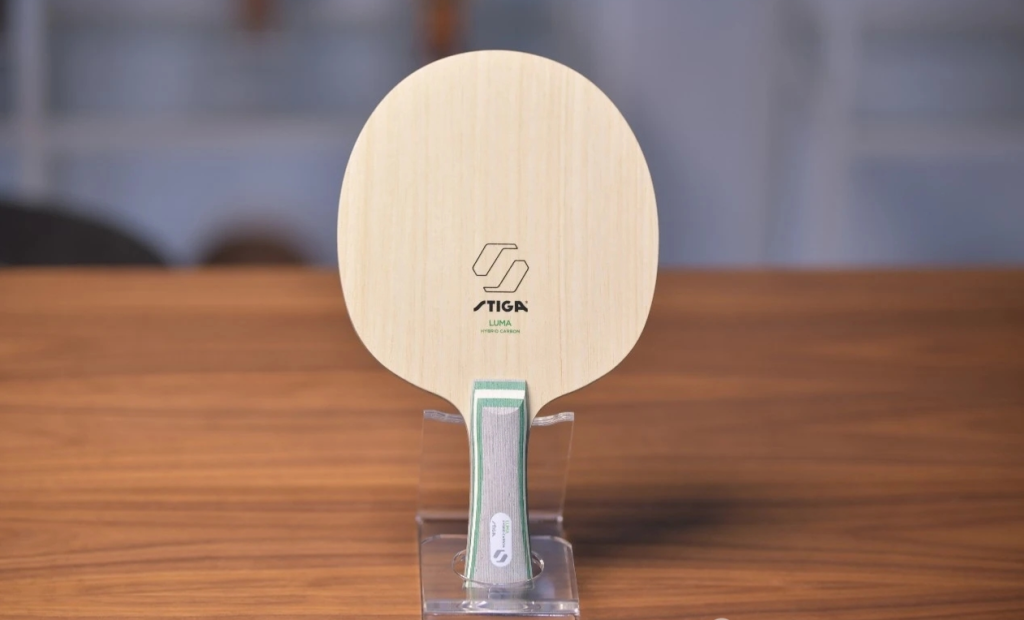
At first glance, the blade looks understated. The handle is clean and simple, with lines that feel somewhat reminiscent of the Butterfly Viscaria. In the hand, the curve and grip also give a familiar, comfortable impression. The green accent on the handle hints at the key material inside: Stiga’s green arylate-carbon layer.
Structurally, the Luma Hybrid Carbon follows a classic 5+2 outer carbon composition: koto outer ply, green arylate-carbon, ayous medial layer, and kiri core. The tested blade measured around 5.80 mm thick and weighed 93.7 g. That sounds heavy on paper, but the balance is excellent. It does not feel clumsy or head-heavy in play.
It is also worth adding that green arylate-carbon seems to be having a real moment this year. Several brands have introduced blades built around this material concept: Sanwei has its 75g model, Yinhe has followed up its flagship Pro 01 with the Pro 01G, and Tibhar has also released Hao Shuai’s blade with green arylate-carbon.
This may well become a new trend in table tennis blade design. The reason is easy to understand: green arylate-carbon has a very distinct playing character. On the forehand side, it tends to offer deeper ball holding, a safer arc, and more margin when looping.
Once you apply power, the stroke does not have to be quite as compact or tightly closed as it often needs to be with blue arylate-carbon blades. For the majority of amateur players, that makes the material easier to use, more forgiving, and likely more attractive in the market.
Feel and Character
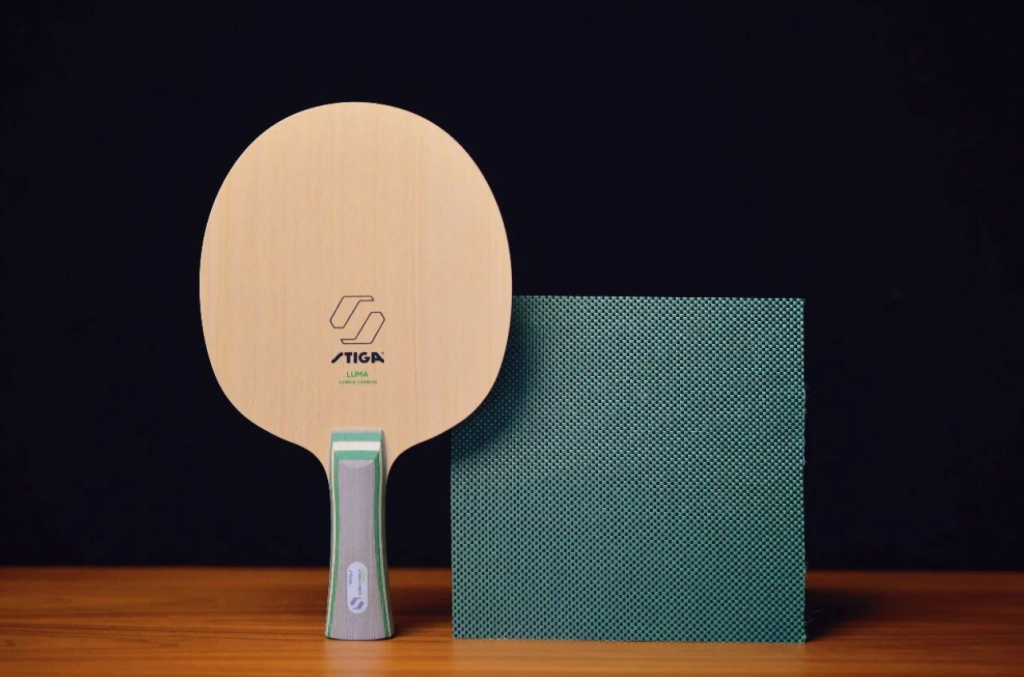
The Luma Hybrid Carbon has a firm, compact feel. It is closer in character to blades such as the Stiga Inspira Hybrid Carbon or Tibhar Alexis Lebrun Krypto Carbon than to softer, more elastic blades. The surface contact feels hard and direct, especially at low to medium impact.
Compared with a Viscaria, the Luma feels harder and more solid in smaller strokes.
When you hit through the blade with more force, however, the inner feel softens slightly and the blade releases more stored energy. The Viscaria is more linear and faithful: what you put in is what you get out. The Luma has a more obvious extra kick once you engage it fully.
That extra rebound is one of the blade’s defining features. It helps you accelerate the ball and create a penetrating first speed, but it can also send the ball long if your timing or touch is not precise. This is not a blade that simply holds your hand through every shot. It rewards players who can apply pressure with confidence.
Speed, Power, and Stability
The Luma Hybrid Carbon is clearly built around explosive speed and stability. Its first bounce is fast, the support is very strong, and it feels especially solid when absorbing or countering heavy incoming power. The blade does not feel thin or fragile on impact; instead, it gives a thick, confident response, especially when the rally becomes faster.
In fast exchanges, the Luma feels stable and dependable. It has a generous sweet spot, so blocks, counters, and quick transitions all feel secure. Even when the opponent’s ball carries a lot of speed or topspin, the blade holds its shape well and does not get pushed around easily. This gives you the confidence to stay close to the table and take the ball early.
The speed is direct and penetrating rather than overly spinny or deceptive. The second bounce is not especially “nasty” in terms of spin variation, but the pace and depth are impressive. When you drive through the ball, the Luma sends it forward with a clear sense of weight and pressure.
This makes the Luma particularly suitable for players who like high-tempo topspin exchanges, quick counterattacks, and aggressive close-to-table or mid-distance play. It is a blade that helps you maintain pressure once the rally opens up.
Rubber Pairing
One important point: rubber choice matters.
This is where the setup becomes especially important. The Luma Hybrid Carbon is not a difficult blade in the narrow sense, because it can work with many different types of rubbers. But to bring out its best qualities, the rubber should not be too hard to penetrate. The blade itself already has a firm surface feel, strong rebound, and a very clear extra kick once you hit through it.
If the forehand rubber is also too hard or too dead, the whole setup can become demanding. You may find that the ball leaves quickly, but the blade-rubber combination does not fully open up. In that case, you lose some of the Luma’s natural speed advantage without gaining enough spin or control in return.
For the forehand, I would lean toward rubbers with good bite, clear arc, and a sponge that can be engaged without requiring professional-level impact on every shot. Grippy European or Japanese rubbers are very suitable here. Stiga DNA Platinum, Stiga Helix Platinum, and Butterfly Tenergy 05 are all good examples. They can hold the ball well enough, give the blade a safer arc, and still allow the Luma’s speed and penetration to come through when you accelerate.
Slightly tacky hybrid rubbers also make a lot of sense. They add a little more grip and security over the table, while still keeping enough rebound for fast topspin play. This kind of pairing can make the blade feel more complete: the blade provides the speed and support, while the rubber adds dwell, spin, and safety.
For players who prefer Chinese tacky rubbers, it is better to stay away from versions that are too hard or too difficult to activate. A boosted 39-degree Hurricane 3 Neo Provincial Blue Sponge, for example, would be a more reasonable direction than an overly hard, unboosted sheet. The key is to let the rubber bite into the ball without making the whole setup feel locked.
On the backhand, I would be even more careful. The Luma’s backhand punch and acceleration are excellent, even comparable to a Viscaria, but the extra rebound after full engagement is more obvious. When you hit through the ball, the blade gives you a sudden boost of speed. This is great for backhand counters, punches, and quick rallies, but it can also make the ball fly long if the rubber is too bouncy or too direct.
For many amateur players, a slightly tacky or hybrid-style backhand rubber may be the safer choice. It can hold the ball for a fraction longer, improve control in fast exchanges, and add more spin on openings and backhand flicks. More importantly, it helps calm down the blade’s rebound without making the backhand feel slow.
Since the Luma already has plenty of first speed, you do not need the liveliest rubber possible to create pace. A rubber with a bit more grip and stability can actually make the blade easier to use and more dangerous in real match play.
Short Game and Opening
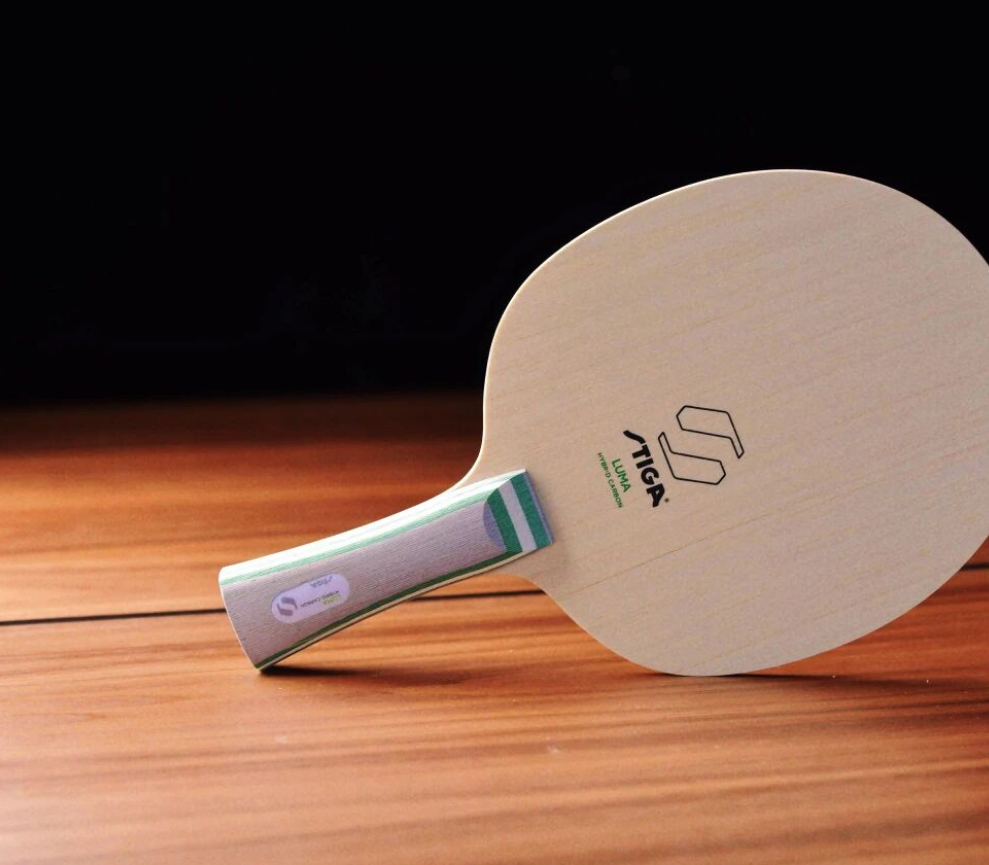
In the short game, the Luma Hybrid Carbon feels stable and composed. The ball does not pop up easily, and the blade gives enough feedback to keep pushes, short touches, and placement shots under control. The touch is slightly woody rather than overly crisp, which actually helps in delicate situations.
You can keep the ball low, vary the depth, and manage the first few shots without feeling that the carbon layer is taking over too early.When opening against backspin, the blade shows a nice balance between grip and speed. It is not the most dwell-heavy blade, but it holds the ball well enough to create a safe arc, especially with the right rubber pairing. Once you add a little acceleration, the ball comes off with good forward pressure.
Backhand flicks are especially threatening with a tacky or hybrid rubber. The ball leaves the blade fast, firm, and heavy enough to put real pressure on the opponent. This is where the blade starts to show its level: even compact, hidden movements can produce dangerous quality.
For advanced amateurs and professional-level players, this is a clear advantage. For lower-level players, it may take some time to control the speed and rebound in the opening phase.
Blocking and Counterattack
Blocking is one of the strongest parts of the Luma Hybrid Carbon’s performance. Whether you are using passive blocks, active blocks, or short punch blocks close to the table, the blade feels exceptionally stable. It has enough stiffness and structural support to absorb heavy incoming topspin without feeling hollow or unstable, yet it still retains enough dwell to let you adjust the direction and depth of the return.
On passive blocks, the blade does not require much extra effort. As long as the racket angle is correct, the ball comes off cleanly with good depth. This makes it very reliable when defending against fast opening loops or continuous attacks.
On active blocks and counter-hits, the Luma becomes more threatening. A small forward movement is enough to add speed and pressure, and the ball leaves the blade with a direct, penetrating trajectory.
What stands out is how composed the blade feels under pressure. Some fast outer-carbon blades can become too bouncy in blocking exchanges, especially when the opponent’s ball is heavy. The Luma Hybrid Carbon is different. It has a strong base, a generous sweet spot, and very little vibration on impact.
This gives the player confidence to hold the line close to the table and turn defense into offense quickly.The blade could also suit penhold players who rely on push-blocking, fast counters, and sudden changes of rhythm. Its stability makes the traditional penhold block feel secure, while its rebound gives enough quality for quick counterattacks.
For players who like to absorb power first and then strike back with pace, the Luma offers exactly the kind of support and sharpness they need.
Close and Mid-Distance Attack
Close to the table, the Luma Hybrid Carbon is fast, clean, and efficient. Forehand and backhand transitions feel smooth, making it a very good option for players who rely on quick exchanges and high rally speed.
From mid-distance, the blade arguably becomes even easier to appreciate. With more space to swing, the power is easier to release. The support remains strong, and the ball carries well through the court.
Still, this is not a beginner-friendly blade. It has a threshold. Players with weaker impact or less developed timing may find it slightly demanding, especially with heavy or hard rubber combinations.
Some Final Thoughts
The Stiga Luma Hybrid Carbon is a serious performance blade. It is solid, fast, explosive, and highly capable in high-speed rallies, blocks, and counterattacks. It is not mainly a soft, transparent, spin-variation blade. Instead, it is a modern offensive weapon focused on pace, pressure, stability, and fast topspin play.
Players who want a blade with strong support, high rebound, and excellent offensive potential should pay close attention to it. Those who prefer a softer, more dwell-heavy feel may want something more flexible and spin-oriented.
The tested sample weighed over 93 g, which may have made it feel slightly harder and more compact. Players interested in the Luma HybridCarbon may want to choose a lighter specimen and pair it with rubbers that are easier to engage. With the right setup, the blade’s threshold becomes much more manageable.
Overall, the Luma Hybrid Carbon is undoubtedly a high-quality blade. It performs extremely well in high-speed rallies and defensive counterattacks, but it does come with a certain threshold. Choosing a lighter specimen and pairing it with the right rubbers will make that threshold much easier to manage.
