
Blog
DHS 301 Series Comparison and Review

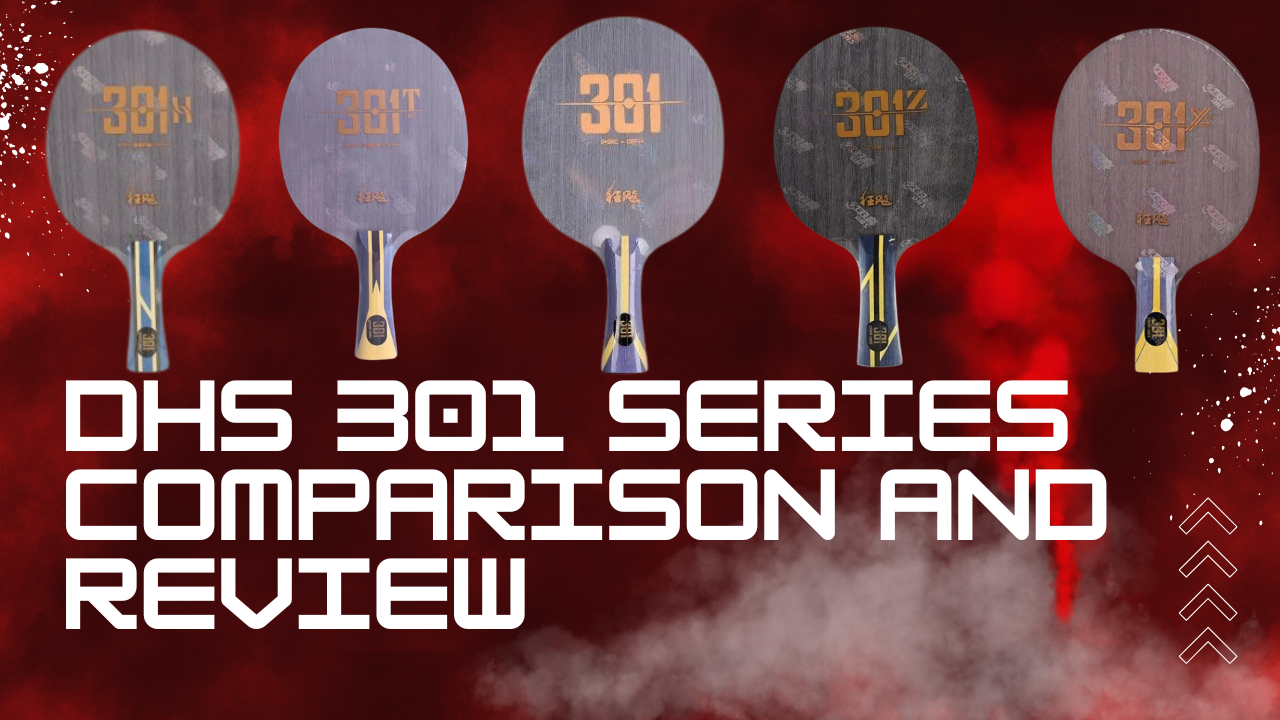
| Image | Product | Features | Price |
|---|---|---|---|
 | A great offensive blade with a firm, fast feel, providing strong stability, control, and power for aggressive topspin and mid-distance attacking play. | Check Price | |
 | An upgraded inner-carbon offensive blade offering a balanced mix of speed, control, and dwell time, ideal for spin-oriented attackers and modern topspin play. | Check Price | |
 | A fast, direct-feel offensive blade tuned for aggressive play, offering strong rebound, solid stability, and reliable control for powerful topspin and counter-attacking. | Check Price | |
 | Check Price | ||
 | A harder-feel offensive blade offering strong power, stability, and a more direct response, ideal for aggressive topspin and fast-paced attacking play. | Check Price |
When it comes to flagship products from DHS, most table tennis enthusiasts immediately think of the Hurricane series, along with the Long 5 and 968 blades. However, beyond these well-known lines, the 301 series is also a classic in its own right.
I first came across this blade about three years ago. At the time, many of my friends who played penhold were using it, which I didn’t quite understand. I asked them why they didn’t go for blades like the Butterfly Taksim or the Butterfly Super Zhang Jike. Their answer was simple: the 301 offers great value for money, and they just didn’t feel comfortable using high-end blades like the Super Zhang Jike.
In 2025, while DHS was launching the Hurricane Long 5H, the 301 series quietly welcomed its fifth member—the 301H. I didn’t include this blade in my “Top 10 New Table Tennis Products of 2025,” mainly because last year was packed with standout releases. Compared to those headline-grabbing products, the 301H felt low-key and didn’t receive much promotion, so it didn’t initially catch our attention.
Unlike the 968 series, which is known for its strong rebound and explosive feel, the 301 lineup focuses more on balancing elasticity and stiffness, following a more moderate and controlled design philosophy. For loopers, the 301 series may not feel as immediately exciting or powerful as the 968 series—especially when it comes to the sensation of looping—but it offers a more practical and consistent playing style. Looking at each model individually, the 301, 301X, 301T, 301Z, and 301H all have their own distinct characteristics, yet they all share the same core identity: a focus on control and practicality.
| Model | Fiber Type | Structure Feel | Stiffness | Speed | Dwell / Hold | Control | Playing Style | Key Features | Recommended For |
|---|---|---|---|---|---|---|---|---|---|
| 301 (Original) | Arylate-Carbon | Soft & elastic | Medium | Medium | Excellent | High | Offensive | Classic feel, great value | Beginners to advanced, especially penhold players |
| 301X | Arylate-Carbon (adjusted structure) | Harder, more direct | High | Fast | Moderate | Good | Balanced / passive | Thicker core, higher rigidity, faster rebound | Players who want more stability and speed |
| 301T | Tri-color fiber (Yellow + Blue Arylate + Carbon) | Crisp & explosive | Very High | Very Fast | Moderate | Good | Offensive | Strongest stiffness, fastest in series | Advanced attackers, hitting + loop drive players |
| 301Z | Reinforced “Z” Fiber | Soft, flexible, lively | Medium-Low | Medium | Excellent | Very High | Active / controlled offense | Best dwell, easy to use, forgiving | Players who value control, spin, and consistency |
| 301H | Densified Z Fiber | Elastic + stable (“springy”) | Medium-High | Fast | Good | Very High | All-round / speed-oriented | Balanced performance, strong support, high stability | Players wanting a complete, high-end blade |
DHS 301
The original 301 wasn’t an “instant peak” success like the 506, but even without endorsements from top stars, it still gained plenty of attention and was used by a number of professional players as their main blade. Like the 968, the 301 features an inner-fiber construction and uses yellow-black Arylate-Carbon. However, it differs in its choice of a harder, dyed koto top ply, and its overall thickness is about 0.1–0.2 mm thinner.
The 301 series also adopts DHS’s proprietary “BBT” technology—short for Blade Balance Technology. This is a unique manufacturing process exclusive to the 301 lineup. During the bonding and pressing of the blade’s material layers, a low and stable temperature is used to minimize internal stress and reduce deformation. As a result, the blade achieves better flatness, along with improved stability and durability, while also slowing down performance degradation over time.

In terms of feel, although both are inner-fiber blades, the 301 doesn’t deliver the same explosive rebound as the 968. Instead, it produces a slightly lower, flatter trajectory with excellent stability. Because the blade deforms less overall, it offers a very solid and controlled touch in the short game, with more concentrated feedback.
It also performs well when borrowing power, which is especially beneficial for penhold players—enhancing both over-the-table control and the suddenness of the first attack. This is why quite a few top-level penhold players have had a “honeymoon period” with the 301. Its playing character—“less powerful than the 968 on the forehand, but more stable on the backhand”—actually suits medium-power shakehand players who rely on quick two-wing exchanges.
At the same time, its outstanding control and strong performance on passive shots make it ideal for modern penhold two-wing looping as well. Compared to the 968, which favors a more explosive, all-out attacking style, the 301 is a blade that truly adapts to both penhold and shakehand play.
This also answers the question I raised at the beginning—why so many penhold players are drawn to this blade. And for that very reason, I’ve included this often-overlooked blade in my list of the top 10 penhold blades.
DHS 301X
Later, the DHS company launched the “X” upgrade program, refining many of its best-selling blades—including the 301.
In essence, the “X” program focuses on adjusting the internal structure without changing the original materials. (The 506X and the defensive 08X are exceptions.) By slightly thinning the outer layers and thickening the core, the overall blade thickness is increased to over 6.0 mm, resulting in noticeably improved stiffness. If you tap the bare 301X blade, the pitch is clearly higher than the standard 301, which reflects this increase in rigidity.
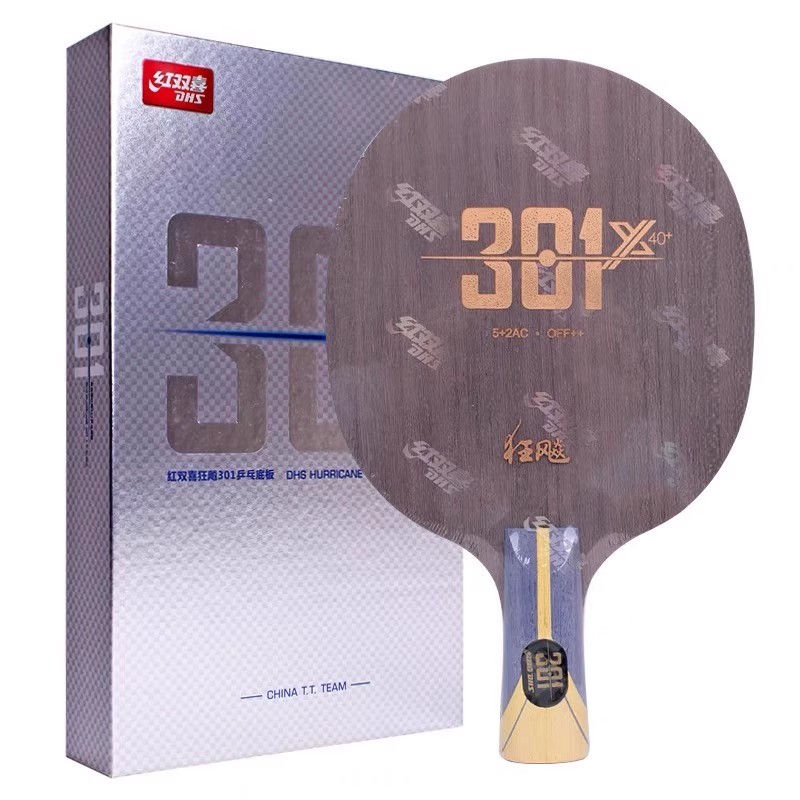
In terms of feel, the 301X is distinctly harder than the 301. It handles the heavier 40+ ball more comfortably and offers a clear boost in speed. For example, quick exchanges like blocks and counters come off faster, and pushes feel more solid and stable.
Of course, every design change comes with trade-offs. With the same materials but a stiffer structure, some elasticity is inevitably lost, which leads to a few downsides. Compared to the 301, the 301X doesn’t “hold” the ball as well, and its trajectory tends to be lower and flatter.
DHS 301T
We all know that the “X” in 301X comes from DHS’s “X Program” developed around the 40+ ball era. But what does the “T” in 301T stand for? The official explanation hasn’t been clearly stated, but there are some reasonable interpretations.
One possibility is that “T” stands for Triple, as the 301T features DHS’s self-developed tri-color composite fiber. Most composite fibers on the market are made from two materials—for example, both the 301 and 301X use arylate-carbon (a blend of yellow arylate and carbon). In contrast, the 301T’s tri-color fiber combines yellow arylate, blue arylate, and carbon, forming a three-way hybrid structure.
Another possible meaning of “T” is Turbo. Within this tri-color fiber, yellow arylate provides a softer feel with excellent flexibility, while blue arylate is relatively harder and more brittle. Combined with carbon, this structure significantly increases the rebound speed of the 301T. It is noticeably faster than the 301X, while still maintaining strong control. At the same time, the feel is crisper, making it especially suitable for direct hitting as well as loop drives that combine hitting and brushing. In terms of stiffness, the 301T stands at the top of the entire 301 series.

In addition, the handle design of the 301T has been completely updated. The previous “Y”-shaped pattern has been replaced by a new combination of triangular elements and double stripes, giving it a fresh visual identity. However, the handle badge itself remains relatively simple, still featuring a large “301.” Beneath the number, you can faintly notice a subtly stylized letter “T”—perhaps a nod from DHS to the debut of its tri-color fiber technology.
DHS 301Z
Released in 2022, the 301Z features a newly developed dual-fiber composite from DHS. According to the official description, this is a reinforced aramid-based material that further enhances fiber toughness while delivering a cleaner, more transparent feel compared to traditional arylate-carbon constructions.
“Flexible fibers for inner layers, stiffer fibers for outer layers”—this has long been a common configuration among major brands. Softer, more elastic fibers are well-suited for inner placement, as they can better utilize the deformation of the blade structure. Paired with a resilient ayous core, this setup enhances both dwell time and feedback during impact.
With the 301Z, the 301 series returns to its original soft and elastic character, even going a step further than the first-generation 301. The arc is fuller, the touch is more lively, and the “inner-fiber” effect feels especially pure. Compared to its predecessors, the 301Z is noticeably softer and offers greater ball-holding ability.

Thanks to the enhanced deformation capability, the blade is also more forgiving and easier to use. At the same time, its underlying power has been improved compared to the original 301, allowing it to better handle stronger strokes. While the feeling of explosive power is still not as pronounced as that of the DHS Hurricane Long 5, its stability in defensive play remains highly reliable.
Compared with the 301X and 301T, which are relatively stiffer and rely more on incoming pace, the 301Z offers greater deformation and a more “active” playing character. For players who value strong dwell time, higher tolerance, and overall control, the 301Z stands out as a highly cost-effective inner-fiber blade worth considering.
DHS 301H
We had already seen DHS’s “densified fiber” technology in the earlier Hurricane Long 5H. In fact, the densified fiber used in the Long 5H is based on the same Z-fiber found in the 301Z, but with increased weaving density. In that sense, from a purely material perspective, the 301H could be considered even more “authentic” in lineage.
The idea of “densified fiber” is fairly straightforward. Most modern composite fibers are made by weaving together two materials—for example, the commonly known arylate-carbon is a hybrid of arylate and carbon. Densification simply means increasing the fiber density per unit area, thereby enhancing the overall strength of the fiber layer and improving the blade’s stiffness.
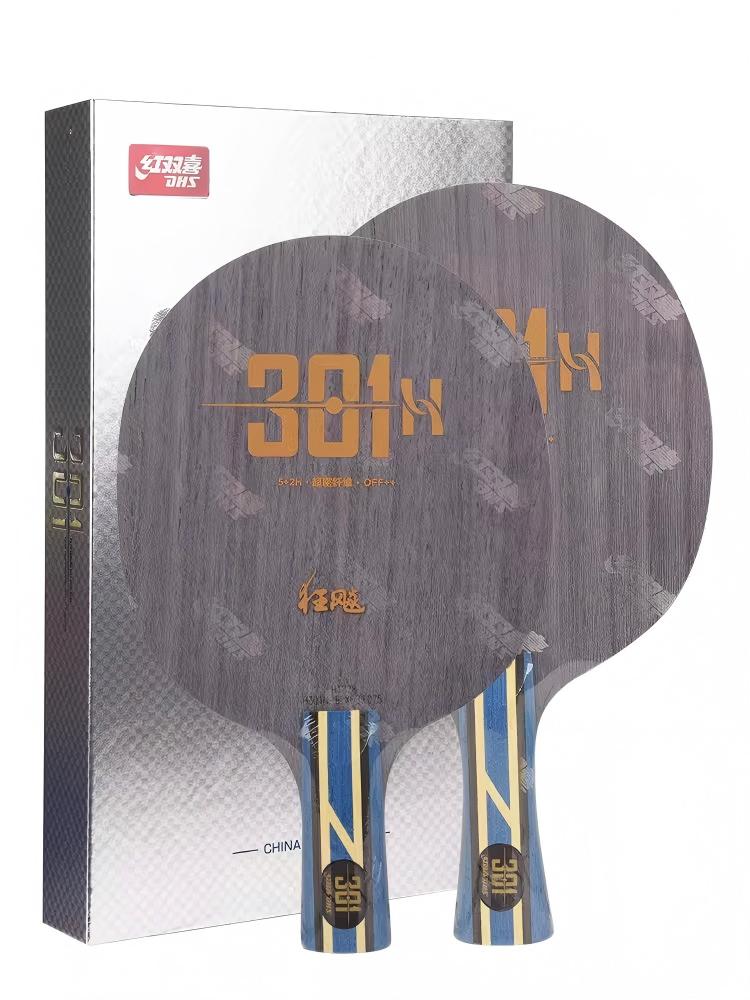
When selecting the material for densification, DHS evaluated its existing fiber technologies and ultimately chose Z-fiber, likely due to its excellent toughness. Another key advantage of densified fiber is that it can significantly increase stiffness without increasing blade thickness. This is particularly important for professional players using inverted rubbers on both sides, as even slight increases in thickness can affect short-game control. Keeping the blade under 6.0 mm allows for greater flexibility in touch play over the table.
In terms of feel, the 301H inherits the naturally flexible character of the 301 structure, while the densified fiber adds a noticeable boost in rigidity. The most immediate impression is a sense of “springy elasticity”—not as soft and elastic as the 301 or 301Z, and not as hard and crisp as the 301X or 301T, but somewhere in between, with a balanced, resilient feel. On the forehand, the arc length is arguably the best within the 301 series, while on the backhand, the improved support is clearly noticeable. Whether in quick blocks or countering strong shots, the stiffness of the 301H provides a reassuring level of stability.
That said, the core character of the 301H still leans toward a speed-oriented style. The absolute quality of its loops is still slightly behind blades from the Hurricane Long 5 (968 series), but it offers a lower entry barrier and a more well-rounded overall performance. While it may not push any single aspect to the extreme, for players seeking consistent and stable output within the 301 lineup, the 301H can be seen as a true “culmination model.”
Some Final Thoughts
For many table tennis enthusiasts, it’s a good idea to start with the 301 as an entry point. Despite the many upgrades and variations that came later, the original 301 remains a timeless classic. It is especially well-suited for penhold players, who can use it as a main competition blade paired with their preferred tacky or grippy rubbers, such as the DHS Hurricane 3 or DHS Gold Arc 8. In terms of overall value for money, the 301 still stands out as one of the best choices in the series.
For players with more specific preferences, the 301T or 301Z are worth trying—especially the 301Z. Whether used in penhold or shakehand grip, it offers excellent ease of use. While it may not reach the level of the Hurricane Long 5, it is much more user-friendly and accessible.
Finally, for those with a higher budget who want a more complete solution right away, the latest 301H is a strong option. Its main drawback is simply the higher price, which may exceed the budget for some players. However, in my personal opinion, its performance fully justifies the cost.

Thank you!