
Blog
Top 10 Cheapest but Surprisingly Good Table Tennis Blades (Part 2) – $30–$50

| Image | Product | Features | Price |
|---|---|---|---|
 | - Offensive Blade: designed for fast and aggressive play | Check Price | |
 | Offensive ALC blade with inner aluminum-carbon for a soft but powerful feel. Balanced speed and control with a large sweet spot, suited for all-round attackers and spin-oriented loopers. | Check Price | |
 | Check Price | ||
 | Featuring an outer carbon construction, this blade offers a fast, direct response with strong rebound and reliable stability for aggressive topspin and counter play. | Check Price | |
 | Check Price |
In our last article, we shared some amazing table tennis blades under $30 — true best-value picks that give budget-conscious players plenty of options.
This time, we’re raising the budget a bit — up to $50 — to see what new blades we can discover. With a higher budget, the possibilities expand, and there are even more high-quality blades worth trying out.
So, let’s dive in and check out some of the top choices! And of course, if you have any favorite blades to add, don’t hesitate to share them in the comments — we’d love to hear your suggestions.
Yinhe Pro 01
At the $50 price point, the Yinhe Pro 01 is often regarded as the best value penhold or shakehand blade — it’s hard to imagine anyone disagreeing. This blade is a true classic and has long been considered the perfect budget-friendly alternative to the Butterfly Viscaria. Its popularity remains high, and it’s widely chosen by players using either penhold or shakehand grips.
The Pro 01 offers a well-balanced, offensive feel that combines speed, control, and spin potential. Built with a 7-ply design featuring both wood and arylate-carbon (ALC) layers, it delivers excellent energy transfer and a stable sweet spot, making loops, drives, and mid-distance attacks feel confident and controlled. While it’s not as stiff as some pure carbon blades, it provides a lively yet predictable response, ideal for players looking to develop consistent loop techniques without sacrificing power.

Pro 01 works well for both forehand and backhand attacks, handling spin and mid-distance rallies reliably. This blade has a slightly head-heavy balance, so we recommend pairing it with a slightly harder rubber, such as Butterfly D09C. This combination allows for faster, more powerful strokes, making offensive shots much more explosive. With aggressive heavy loops, you can put significant pressure on your opponent, making it much harder for them to respond effectively.
Sanwei 75
At the $50 price point, if there’s any blade that can compete with the Yinhe Pro 01, it’s definitely the Sanwei 75. In a previous review, we compared the Yinhe Pro 01 and Sanwei 75 side by side — you can check that article if you’re interested. The Sanwei 75 series actually includes several versions, including both outer and inner constructions. Here, we focus only on the inner version, as it is more widely used and preferred by attacking players.
The Sanwei 75 Inner ALC is a standout budget offensive blade that offers a strong balance of power, control, and feel, making it one of the most compelling choices in the $50 range for players looking to step up from basic blades.

The inner-core ALC construction places the arylate-carbon layers closer to the core, providing a softer feel with increased dwell time and better control, while still delivering plenty of offensive capability. This allows players to generate solid topspin loops, controlled drives, and confident counter-attacks without the overly stiff feedback that some carbon blades can produce.
Many players like this blade because of its balanced offensive performance — it’s fast enough for aggressive loops and drives, yet stable enough to handle mid-distance rallies and transitional play. The combination of all-wood warmth and composite consistency makes it ideal for intermediate players and developing attackers who want powerful strokes with reliable touch and placement.
Compared to outer versions or other carbon blades at similar price points, the inner ALC 75 offers richer feedback and a more touch-friendly surface, helping players judge spin and placement more accurately. Its lively but controllable feel is especially beneficial for loop-oriented attacks and balanced offensive play.
DHS Power G7
While DHS is best known for flagship blades such as the Hurricane Long series and the 968, the brand also offers several highly competitive budget-friendly options. Among them, the Power G7 series stands out as one of the most popular and best-value choices.
Compared with pro01 and Sanwei 75 that we mentioned earlier, the Power G7 comes in at a much more affordable price point—usually just a little over USD 30—yet still delivers very respectable performance.
The Power G7 series actually includes several variants, such as Power G7, G7X, G7H, and G7S. Among them, the standard Power G7 (PG7) is by far the most widely used and also the most classic model. While some players (including ourselves) appreciate the firmer feel of the 7-ply all-wood G7H, we will focus here on the PG7, as it best represents the core characteristics of the series and has the largest user base.

This blade is widely regarded as one of the most iconic budget offensive blades on the market. Built with a classic 7-ply all-wood structure, it offers a well-judged balance between speed, control, and feel—something that is increasingly rare at this price point. From improving attackers to experienced club players, the PG7 has earned a reputation as one of the most trustworthy value-oriented all-wood blades available.
Compared with many fast carbon blades that can feel rigid or unforgiving, the Power G7 provides a noticeably more natural and elastic wood feeling. The ball sinks into the blade well, giving players solid dwell time and reliable feedback. In terms of speed, it sits comfortably in the OFF- to OFF range, delivering enough power for modern attacking play while still maintaining controllability for placement and variation.
In terms of rubber pairing, the PG7 is highly adaptable. Medium-to-hard, grippy rubbers complement its looping strengths and bring out its offensive potential, while slightly softer rubbers can enhance touch, control, and short-game stability for players who favor consistency over raw power.
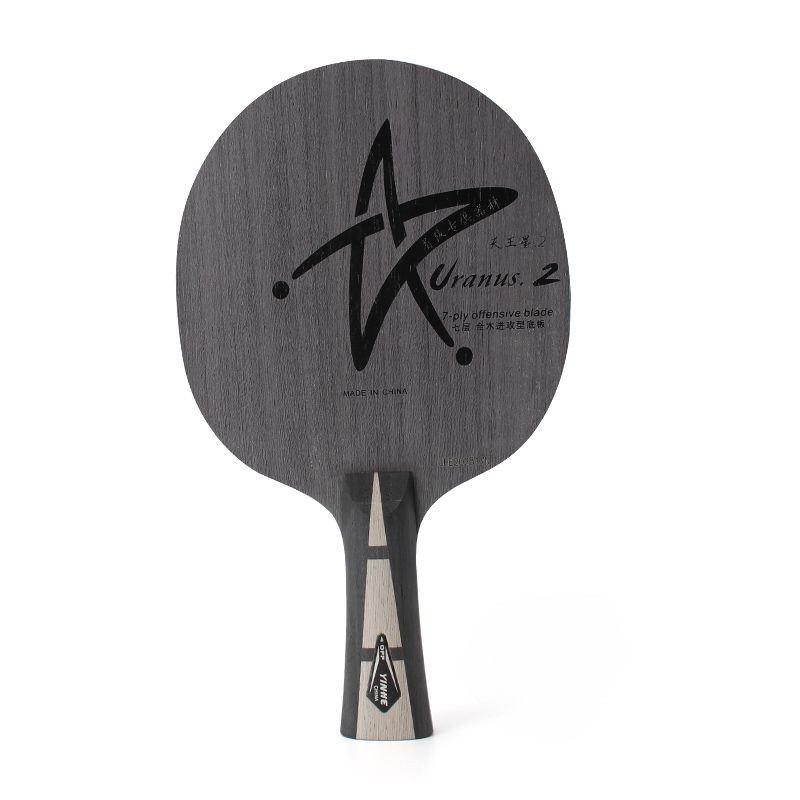
Yinhe Uranus U-2
When it comes to value-for-money blades, Yinhe is one of the first brands that comes to mind. Much like the DHS Power series, Yinhe’s Uranus lineup has become a classic at the $30 price point.
The Uranus series currently includes four blades: the traditional U1, U2, U3, and the newest U2-Spin (U2S), which is an upgraded version of the U2 with several improvements and optimizations. Among these, the U2 remains the most popular and widely recognized, making it the flagship of the series for budget-conscious attacking players.
The Yinhe Uranus U-2 is a 7-ply all-wood offensive blade that delivers a balanced combination of speed, control, and feel. It is especially well-suited for players who want a dependable all-wood option for looping, driving, and mid-distance attacking without stepping up to carbon blades.

The U-2 provides a solid, lively hitting sensation with consistent energy transfer across the blade face, giving players reliable feedback and a comfortable sweet spot. Typical weight ranges from 84–87 g, with a thickness around 6.0 mm, which allows for quick transitions and stable timing during aggressive strokes.
Players often praise the U-2 for its well-rounded offensive capabilities. Its all-wood construction allows players to generate heavy topspin with a slightly higher trajectory, which makes controlling both the depth and spin in mid-distance rallies much easier. At the same time, the blade’s thoughtful balance of flex and stiffness provides enough power for drives and counters while maintaining precise control, so aggressive strokes feel confident rather than erratic.
Even in close-to-table situations, the U-2 delivers reliable performance: blocks and quick attacks are predictable thanks to its stable rebound and clear tactile feedback, giving players a sense of consistency whether they are looping from mid-distance or playing fast exchanges near the table.
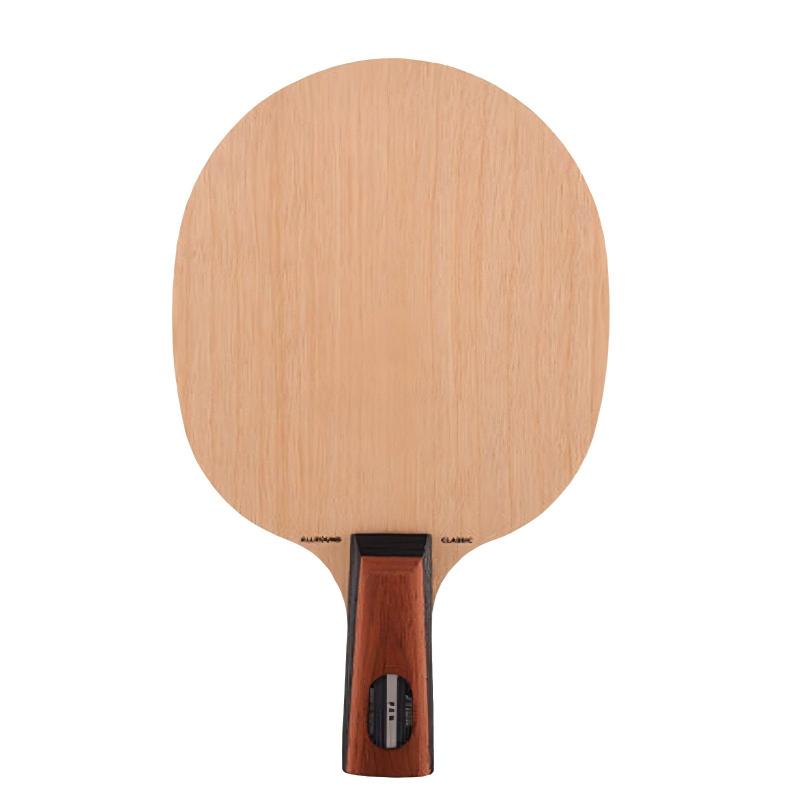
Stiga Allround Classic
The Stiga Allround Classic is one of the most enduring and respected all-wood blades in table tennis history. First introduced in 1967, it has remained popular for decades due to its balanced feel, excellent control, and versatile performance, making it a classic choice for a wide range of players from beginners to experienced all-around competitors.

Built with a 5-ply all-wood construction, the Allround Classic delivers a soft and responsive touch with very good ball dwell time, which helps players generate spin more easily while maintaining consistent control during rallies. Its moderate speed and predictable rebound make it especially suitable for players focusing on technique development, placement, and reliable all-around play rather than raw power.
Weighing around 85 grams with a relatively thin profile, the blade feels nimble and easy to maneuver, reducing fatigue during long training sessions. Players often describe its feedback as clear and tactile, making it easier to judge spin and contact — a key reason why many coaches recommend it for beginners and developing players.
Because of its classic feel and forgiving performance, the Allround Classic performs well in a wide variety of strokes, including loops, blocks, pushes, and serve-receive play. While it is not designed for extreme speed or highly aggressive offensive strokes, with the right rubber pairing, it provides a stable and confidence-boosting game that helps players refine foundational skills.

Could you please describe the layers wood composition of these blades? Tks !