
Blog
Irregular Shape Table Tennis Blades

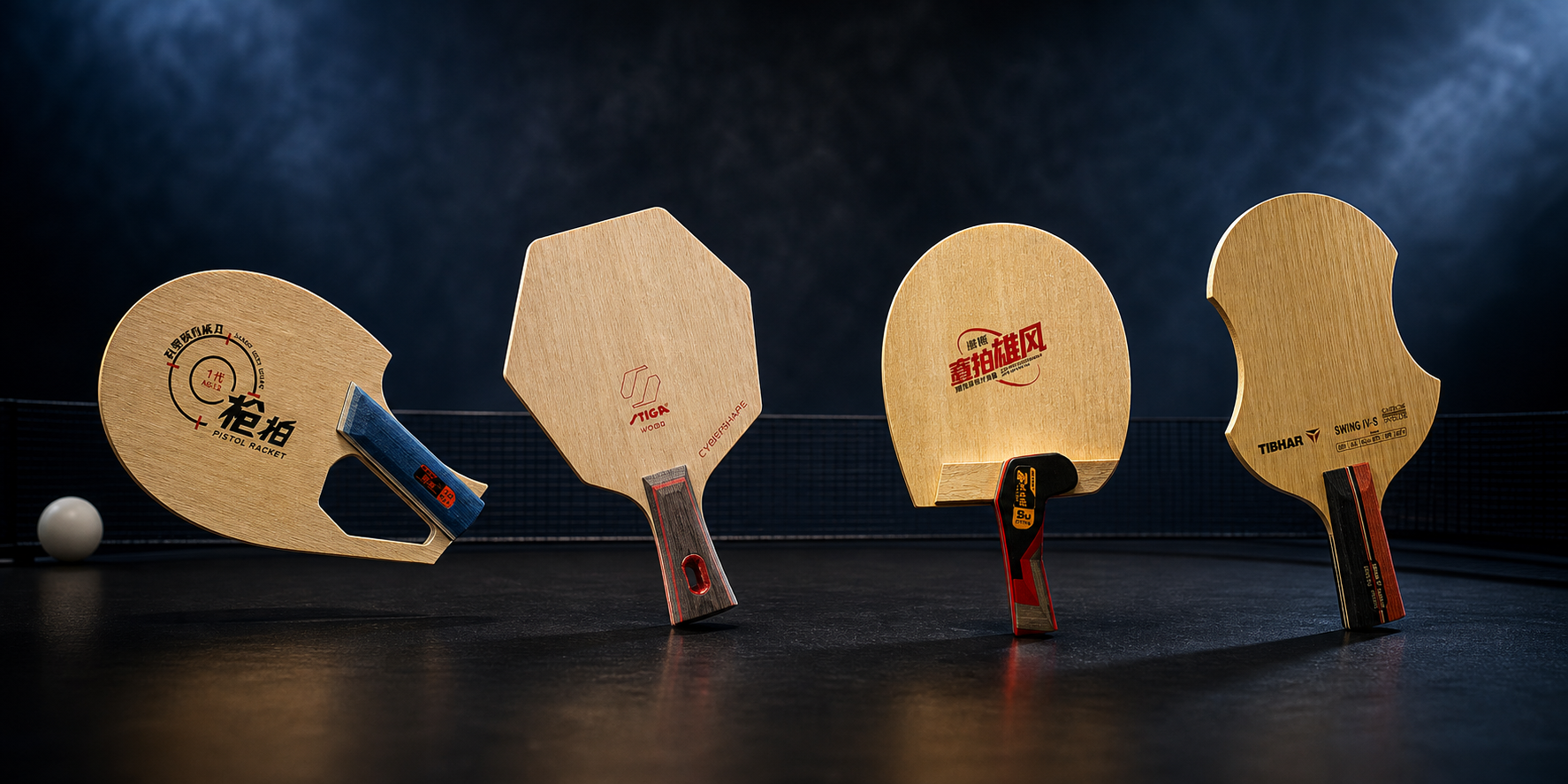
For more than a century, most table tennis blades have followed the same basic idea: a rounded head, a conventional handle, and only small differences in size or composition. Players argue endlessly about limba or koto, inner carbon or outer carbon, stiff or flexible feel, but when it comes to shape, the sport has usually been very conservative.
So today, let’s switch things up a bit.
We spend so much time reviewing all kinds of table tennis equipment that things can start to feel a little too serious and technical. But when you really think about it, most of us table tennis enthusiasts aren’t professional players. More than anything, we’re here to enjoy the fun and joy that table tennis brings into our lives.
So today’s topic is going to be much more relaxed. We’re going to take a look at some of the weird, unusual, and downright fascinating table tennis paddles out there — some come in strange shapes, some have bizarre designs, and chances are, there are quite a few you’ve never even seen before. But one thing’s for sure: they’re all incredibly interesting.
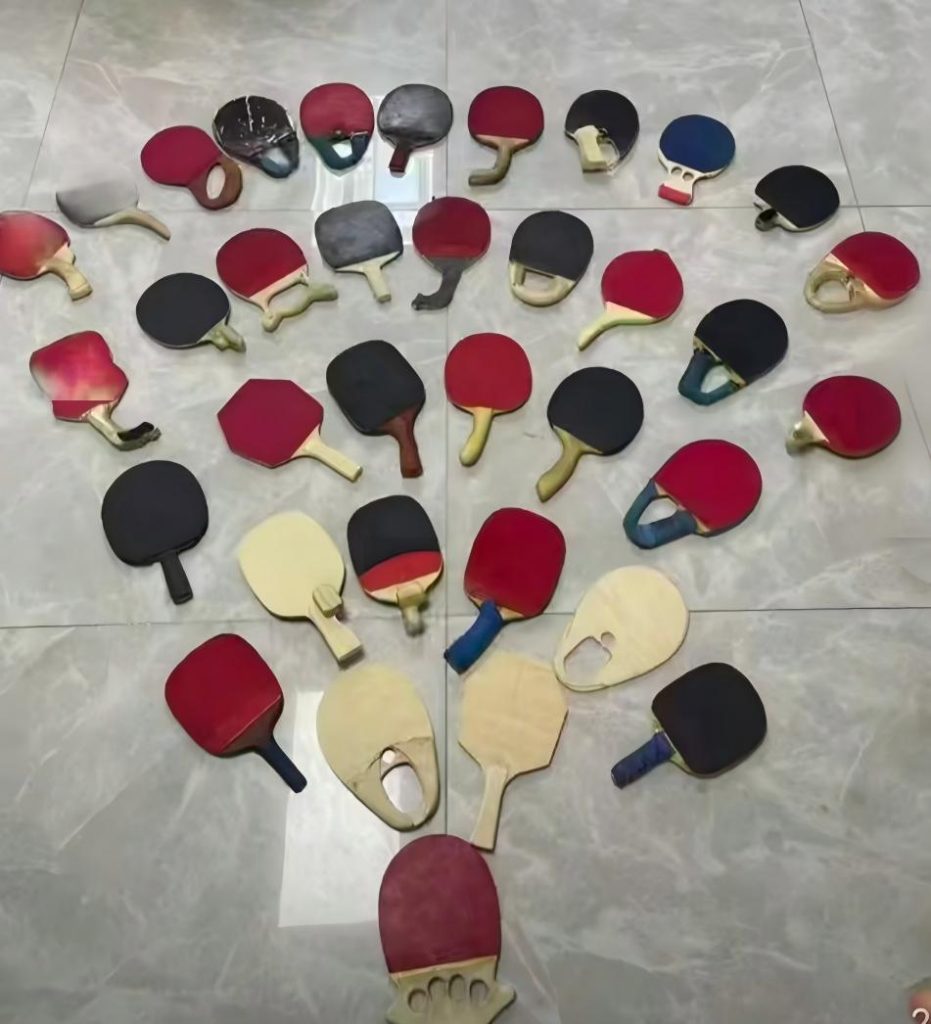
The photo below shows part of a friend’s collection. He especially loves collecting all kinds of unusual and oddly shaped table tennis blades. One day, he sent me this picture, and I was absolutely shocked!
Are Irregular Shape Blades Legal in ITTF Tournaments?
Before talking about specific irregular blades, it is worth clearing up one basic question: are they actually legal in official competition?
The answer is yes. Under the ITTF Laws of Table Tennis, a racket may be of any size, shape, or weight, as long as the blade itself is flat and rigid and the racket complies with the rest of the equipment rules. In other words, the ITTF does not require a blade to have the traditional round or oval shape that most players are used to.
This is why irregular designs have always been possible, at least from a rules perspective. The freedom to experiment with different head shapes or unusual handle designs has been there for a long time. What has limited their development is not legality, but player acceptance. Table tennis is a sport built on timing, touch, and visual confidence, so even a small change in shape can make players feel uncertain.
Of course, shape alone does not make a blade legal. It still has to meet the rest of the ITTF requirements, including proper blade construction, approved racket coverings, and correct assembly. But as long as those conditions are met, an irregular blade can absolutely be used in ITTF competition.
That is exactly why blades such as the Tibhar Swing IV-S, the Stiga Cybershape, and other unconventional designs have been able to enter serious discussion over the years. They may look very different from standard blades, but under ITTF rules, different does not automatically mean illegal.
Tibhar Swing IV-S: an early attempt to break the traditional blade shape
Long before the Stiga Cybershape became one of the most talked-about blade designs in modern table tennis, Tibhar had already explored the idea of a non-traditional blade shape with the Swing IV-S. In the history of irregular shape blades, this is one of the earliest commercially recognizable examples from a major brand, which is why it deserves much more attention than it usually gets today.
Although it is difficult to confirm the exact commercial launch date from Tibhar’s current official materials, the Swing IV-S can be reliably traced back to the early 2000s, and its roots may go back even further. Archived equipment references show that the blade was already in circulation by 2003, while historical material linked to Damien Eloi suggests that the violin-style blade concept associated with Tibhar had already appeared in the mid-1990s. That makes the Swing IV-S an important milestone, not because it became a mass-market bestseller, but because it showed that a serious brand was willing to challenge one of the most deeply accepted assumptions in table tennis equipment design.
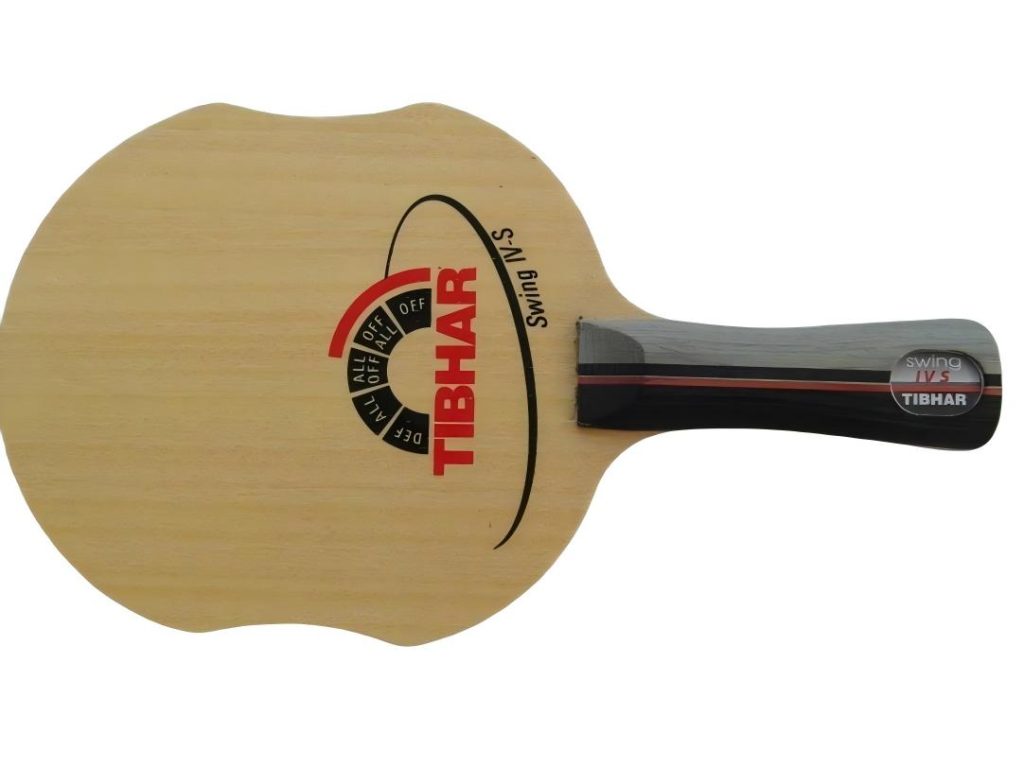
What made the Swing IV-S stand out was not only that it looked unusual, but that it came from a performance-oriented blade family rather than from a novelty line. In other words, Tibhar was not simply making a funny-shaped racket for attention. It was testing whether blade geometry itself could become part of performance design. At a time when most players were still extremely conservative about head shape, this was a bold move.
The market, however, was probably not ready yet. Table tennis players are famously sensitive to changes in feel, balance, and visual alignment, and many players tend to distrust anything that looks too different from the classic blade outline. As a result, the Swing IV-S never became a mainstream design revolution. Still, from a historical perspective, it was clearly ahead of its time. It helped establish the idea that irregular shape blades could exist as real competitive equipment rather than as mere curiosities.
Stiga Cybershape: the design that pushed irregular blades into the spotlight
If the Tibhar Swing IV-S was an early experiment, then the Stiga Cybershape was the product that truly brought irregular shape blades into the center of public discussion. Stiga officially introduced the Cybershape in 2021 after years of research and development, including testing of sound, vibration, and hitting surface in cooperation with KTH Royal Institute of Technology in Sweden. According to Stiga, Truls Moregard made the first official appearance with the Cybershape on November 1, 2021, but the blade’s real breakthrough came later that same month, when he made his sensational run to the men’s singles final at the 2021 World Table Tennis Championships in Houston, with the final played on November 29, 2021.
That Houston run was the turning point. Before then, the Cybershape might still have been seen as an unusual design experiment. After Moregard reached the World Championship final with it, the blade suddenly became a global talking point. Players, coaches, equipment testers, and fans all started asking the same question: was this shape only visually different, or did it offer genuine performance advantages? That is the moment when irregular blade design became mainstream again.
Why Cybershape attracted so much attention
One reason the Cybershape created such a strong reaction is that Stiga did not present it as a gimmick. The brand positioned it as a research-driven performance blade. According to Stiga’s published product information, the Cybershape was engineered around the idea that the optimal hitting area for most players lies in the upper half of the blade. For that reason, the hitting area was redesigned to be larger in the upper section, while the lower part was reduced slightly to maintain balance. Stiga also states that the sweet spot is positioned higher on the blade and extends further outward compared with a traditional blade shape.
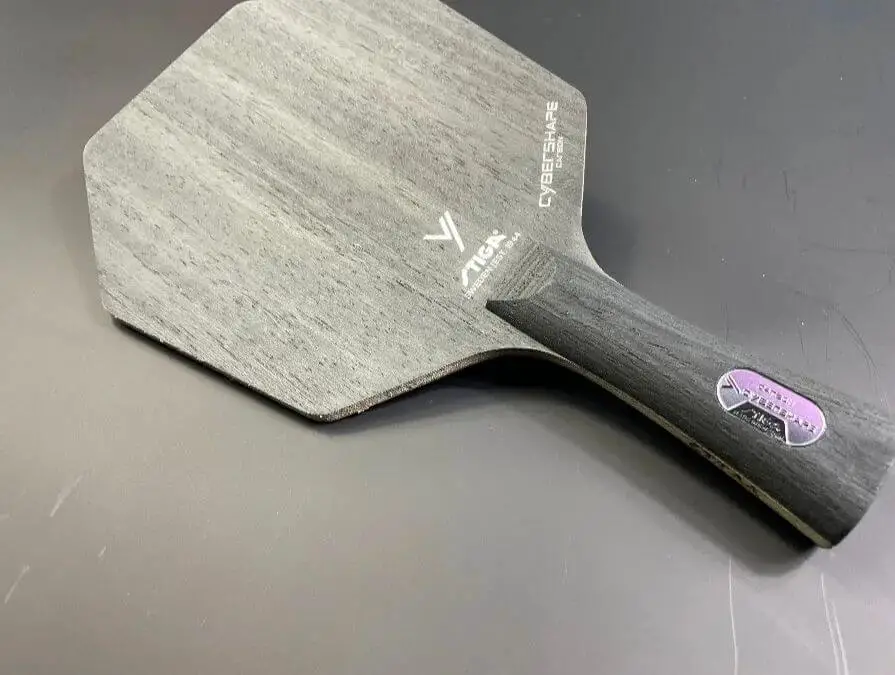
Stiga further claims that the Cybershape offers practical advantages in the short game and receive game. Because of its geometry, the effective hitting area can come as much as 6.5 cm closer to the table during returns, compared with 2.5 cm for a conventional round blade. The company also highlights that the multiple angles of the head can make it easier for players to visualize racket angle and vary spin on serve.
Whether every player will experience these advantages in the same way is another matter, but the key point is that Cybershape gave the table tennis world a technical reason to take irregular blade design seriously. It was not just different for the sake of being different.
Why Moregard chose the Cybershape
Stiga has never framed Moregard’s choice as a purely cosmetic one. The likely reason he committed to the Cybershape is that its design matched the demands of his playing style. Moregard plays with excellent timing, aggressive backhand initiative, sharp over-the-table control, and a lot of touch in transition phases. A blade that offers a larger optimized hitting area in the upper half, a sweet spot positioned higher on the face, and better access in short receive situations would naturally appeal to a player like that.
Stiga’s own explanation supports this idea. The company emphasizes better control on short serves and returns, easier blade-angle awareness, and a larger sweet spot without a major weight penalty. Moregard himself has also said that his self-confidence improved significantly once he realized how well he could play with the new Cybershape. So while we should be careful not to overstate any single equipment factor, it is reasonable to say that Moregard did not choose the Cybershape simply because it looked different. He used it because he believed its shape gave him real functional advantages in modern high-speed table tennis.
From one blade to a full Cybershape family
Another sign of Cybershape’s success is that Stiga did not stop with one flagship model. After the original Cybershape Carbon gained attention, the company continued expanding the shape into a much broader product family. Official Stiga product pages now include models such as Cybershape Carbon, Cybershape Carbon CWT, Cybershape Wood, Cybershape Wood CWT, Clipper Cybershape, Pure Cybershape, and Aura Hybrid Carbon Cybershape. In retail channels, the family has expanded even further depending on market and region, with listings such as Allround Classic Cybershape, Destiny Carbon Cybershape, Wavy Ultra Fiber Cybershape, Chinese penhold versions, and special Truls editions.
This expansion is important historically. It shows that Cybershape was not just a one-off publicity success built around one player. It became a platform. Once Stiga realized that the shape had both competitive credibility and commercial appeal, the brand started applying it across different blade constructions and playing levels, from more accessible all-wood options to premium composite models. In other words, Cybershape evolved from a single experimental blade into a complete product ecosystem.
That, more than anything else, is what separates it from most earlier irregular blade designs. Many unusual blades appear once, create curiosity, and then disappear. Cybershape stayed, grew, and proved that a non-traditional shape could become a lasting product category rather than a temporary sensation.
Sanwei pistol blades: an unusual idea with a clear purpose
When people talk about irregular blades, most of the attention usually goes to unusual blade head shapes. But Sanwei explored a different path. Instead of changing the face of the blade too much, it focused on the handle and the way the player holds the racket.
That is where Sanwei’s pistol blades become interesting.
The basic idea behind this kind of design is actually very practical. A pistol-style handle is meant to fix the wrist a little more, give the hand a more secure position, and help the player transfer power more directly into the ball. In other words, it is not just about making the blade look strange. The goal is to create a grip that feels more stable and more locked in during play.
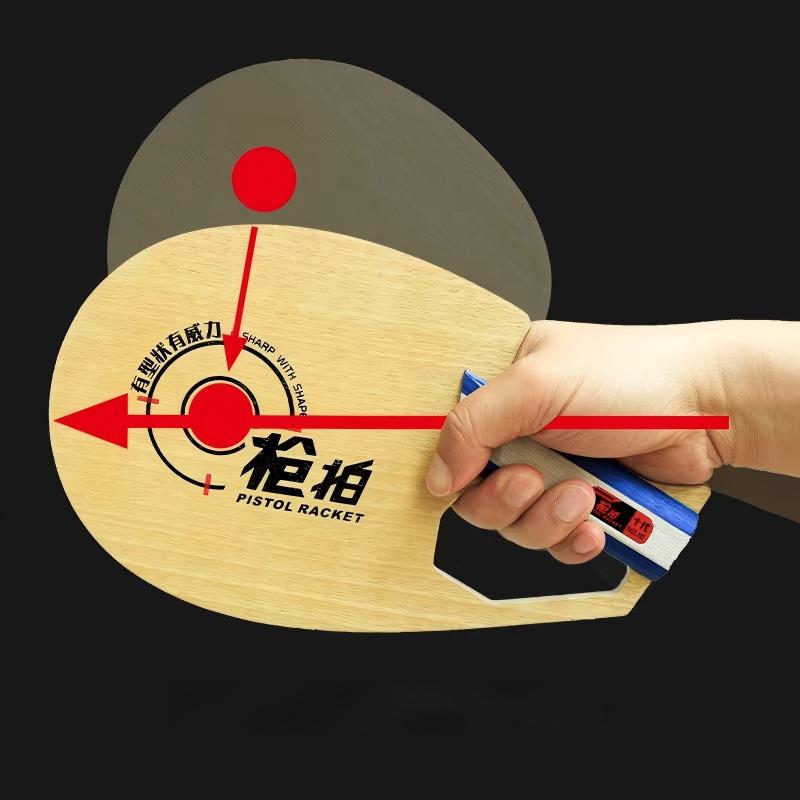
Of course, that also makes these blades much more specialized than something like the Cybershape. A different blade head shape is one thing, but changing the grip itself is a much bigger adjustment. Some players may like the more secure feeling and the more direct power release, while others may feel that it limits the natural freedom of the wrist too much. That is probably why pistol blades have always remained a niche category.
Still, Sanwei deserves credit for going down this path. Most brands never really moved beyond conventional shakehand and penhold structures, but Sanwei was willing to experiment with the mechanics of grip itself. In that sense, its pistol blades are an important part of the irregular blade story, because they show that innovation in table tennis equipment does not always have to begin with the blade head. Sometimes it starts with the handle.
Sanwei Su Large Pincer: an unusual attempt to improve the penhold grip
Among the more unconventional blades developed by Sanwei, the Su Large Pincer series is one of the most distinctive. Compared with irregular blades that mainly change the head shape, this series takes a different route by focusing much more on the grip itself. Its design is not just unusual in appearance. More importantly, it reflects an attempt to rethink how the blade can be held, especially in relation to penhold play.
The basic idea behind the Su Large Pincer design was to improve the penhold grip by giving the hand a more structured and supportive position. Rather than following the conventional penhold handle shape, Sanwei explored whether a more specialized gripping form could create a different kind of hand connection, and perhaps offer some players a stronger sense of stability and control.
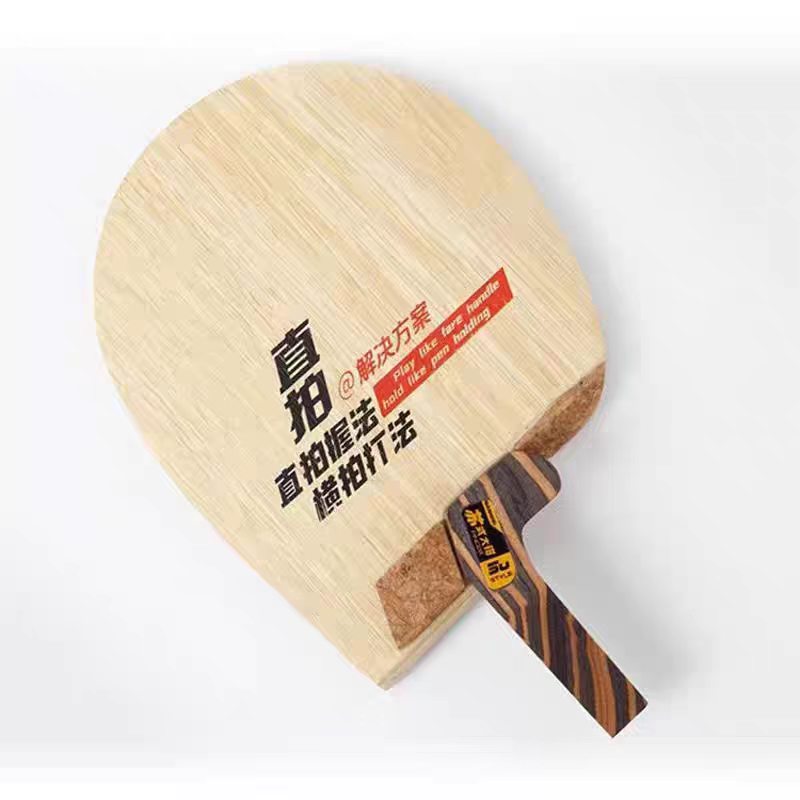
That is what makes this series so interesting in the history of irregular shape blades. It was not simply made to look strange or attract attention. It came from a functional idea, even if that idea was always going to appeal to a very small group of players. In other words, Sanwei was not just experimenting with shape for fun. It was using irregular design to explore whether penhold equipment itself could be developed in a different direction.
What also makes the Su Large Pincer series stand out is that Sanwei did not stop at one single model. Retail listings have included multiple versions such as the D-5W, D-5W2C, D-5W2H, D-5W2K, D-5W2S, D-7W, D-8W3C, and D-981, with some versions even offered for both left-hand and right-hand users. That already shows this was not just a one-time curiosity, but a real product branch within Sanwei’s broader experimentation with irregular blades.
Of course, designs like this are never likely to become mainstream. They are simply too specialized for that. But that does not make them unimportant. If anything, the Su Large Pincer series is a good reminder that the history of irregular blades is not only about famous products like the Cybershape. It is also about the smaller, more experimental ideas that tried to solve specific problems in their own way.
Yinhe Pro 01 fish handle: a hidden oddball in one of Yinhe’s most successful blade series
For many players, the Pro 01 has long been one of the classic alternatives to the Butterfly Viscaria. It offers that familiar outer-carbon offensive feeling that a lot of players are looking for, but at a much more affordable price. That is a big reason why the Pro series has been so popular for years. For players who want something in the Viscaria family without paying premium Butterfly prices, the Pro 01 has always been one of the most recognizable options from Yinhe.
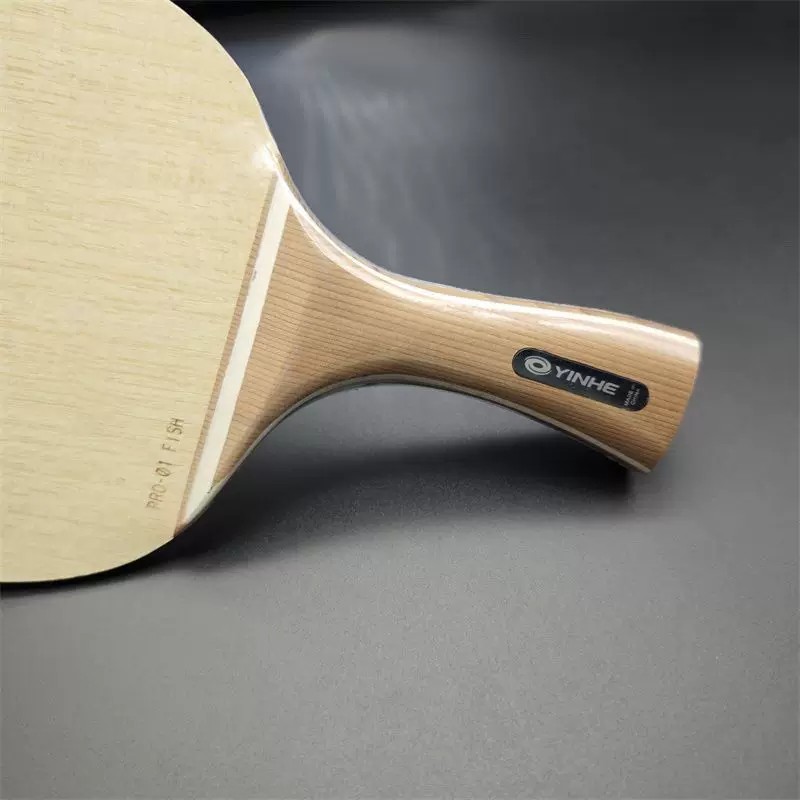
That is exactly why the Pro 01 fish handle feels so unexpected.
When people think about the Pro 01, they usually think about performance, value for money, and its reputation as a serious Viscaria-style blade. They do not usually think about irregular design. But Yinhe did in fact make a much more unusual version within this same series, featuring a distinctive fish-shaped handle.
What makes it interesting is that the blade does not come from some obscure novelty lineup. It comes from one of Yinhe’s most familiar and successful product families. That gives the fish handle version a different kind of charm. It feels less like a random gimmick and more like a strange little side branch of a blade series that many players already know well.
Compared with something like the Stiga Cybershape, this is obviously a much quieter kind of irregular design. The head shape is still familiar, and the playing concept remains connected to the standard Pro 01. The unusual part is mainly in the handle, which gives the blade a more playful and memorable identity.
That may not make it one of the most important irregular blades ever made, but it definitely makes it one of the more interesting ones. For players who already know the regular Pro 01 as a classic Viscaria alternative, discovering that there is also a fish-handle version is exactly the kind of detail that makes the irregular blade category so fun to explore.
DIY and novelty blades: maybe not serious, but definitely fun
Once you get past the products made by the bigger brands, the irregular blade world becomes a lot more relaxed and a lot more fun. This is where you start seeing all kinds of DIY ideas, like axe-shaped blades, mango-shaped blades, and other custom designs that clearly were not made just for serious match play.
To be honest, that is exactly why they are interesting.
Most of these blades are not trying to become the next competitive classic. They are not made to replace a Viscaria, and they are probably not the kind of blade you bring to an important tournament. But they do something else very well: they make people smile. And in a sport where so much of the conversation is always about speed, spin, carbon structure, and price, I think that has its own value.
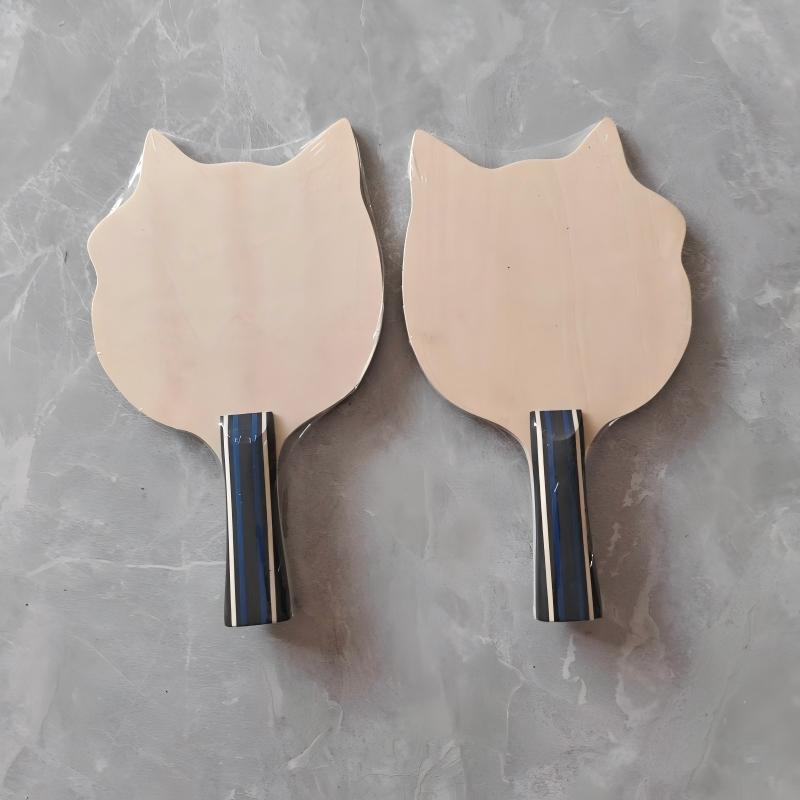
In fact, blades like these can make really fun gifts. If you have a table tennis friend, a doubles partner, or a teammate in your club, giving them a weird custom blade is the kind of thing they will remember for a long time. Maybe they will not use it as their main racket, but they will definitely show it to other people, laugh about it, and probably try it out at least once. That alone already makes it worthwhile.
So even though DIY irregular blades are usually more about fun than competition, I do think they deserve a place in this story. They show another side of table tennis culture. Not everything has to be serious. Sometimes a blade can just be creative, personal, and unexpectedly entertaining, and that is part of the charm too.
